News
General
229 views
What AI can teach us about fatherhood
Jun 22, 2026
📍 Philadelphia, PA, USA
🤖👨👧 **This Father’s Day, AI Offers a New Way to Understand the Timeless Role of Fathers**
As the world celebrates Father’s Day in an era increasingly defined by artificial intelligence, one truth stands out: while technology is transforming how people work, learn, and communicate, the core values passed from one generation to the next remain unchanged.
Today’s fathers are raising children in a world filled with AI-powered tools, chatbots, machine learning, and automation. Yet many of them were raised by parents who never experienced any of these technologies. Instead, they learned lessons rooted in honesty, resilience, responsibility, compassion, and integrity—values that continue to guide families regardless of technological change.
Interestingly, many of the concepts used to explain artificial intelligence closely resemble the responsibilities fathers have carried for generations. AI systems are designed to learn from experience, improve through mistakes, and adapt over time. Parenthood follows a remarkably similar path, where children are encouraged to grow stronger through challenges rather than avoid them.
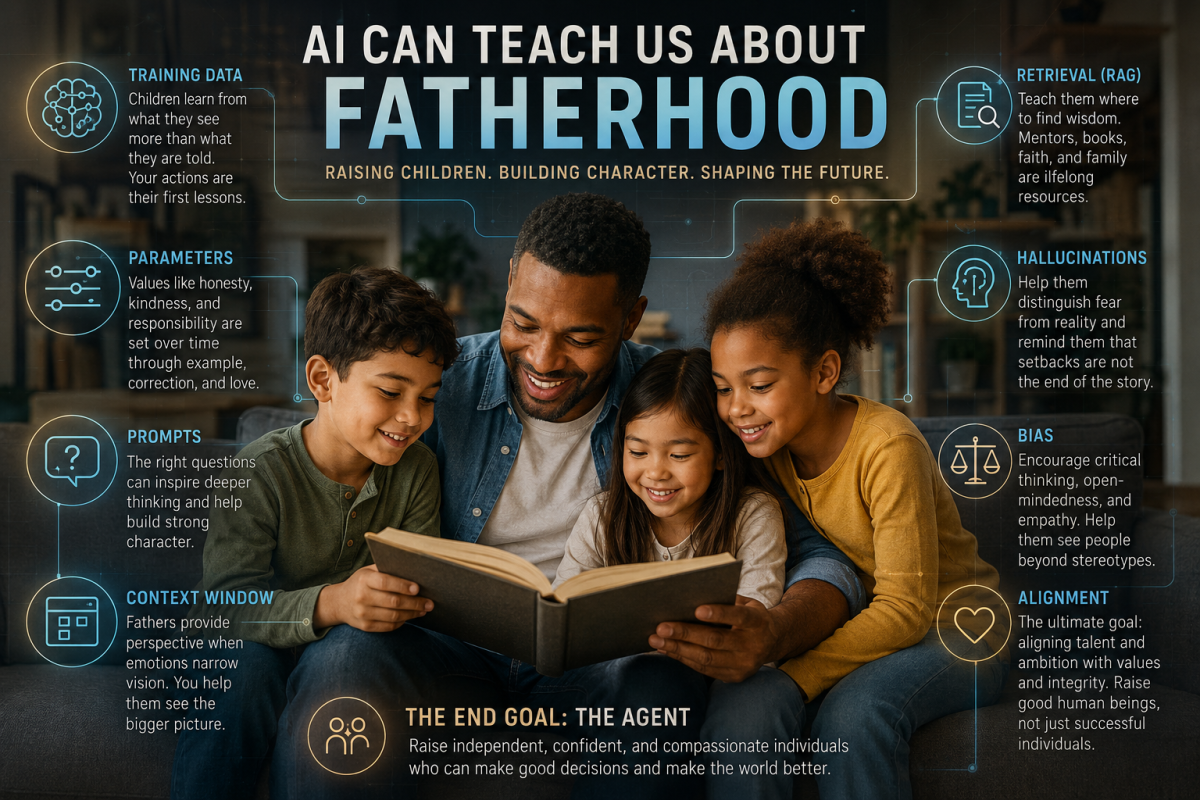
Large Language Models are trained using enormous amounts of information that shape how they respond to the world. Children also build their understanding through continuous observation. They watch how parents solve problems, treat others, respond to setbacks, and demonstrate kindness, often learning more from daily behavior than from spoken advice.
Just as AI operates according to internal parameters that influence decision-making, fathers help establish the internal values that guide their children throughout life. Honesty, empathy, humility, discipline, and respect gradually become part of a child's character through years of consistent guidance and example.
Another important AI concept is the "prompt," where better questions often produce better answers. Effective parenting follows the same principle. Rather than simply providing solutions, fathers often encourage children to ask thoughtful questions, think critically, and make decisions based on reflection rather than impulse.
Artificial intelligence also relies on context to interpret information accurately. Children, however, have limited life experience and often struggle to see beyond immediate challenges. Fathers frequently serve as that broader perspective, helping young people understand that temporary failures, disappointments, or setbacks are only small chapters in much larger life stories.
Modern AI systems increasingly use trusted external knowledge to improve their responses. Likewise, fathers teach children where to seek reliable guidance—from teachers, mentors, books, family members, faith, and trusted communities—preparing them to continue learning long after childhood ends.
AI systems occasionally produce "hallucinations," confidently generating incorrect answers. Human beings experience similar moments of self-doubt, fear, and distorted thinking. Children sometimes convince themselves that one failure defines their future or that one mistake determines their worth. Fathers often help separate fear from reality, replacing uncertainty with confidence and perspective.
Bias is another major challenge in artificial intelligence, developing when systems learn from incomplete or distorted information. Human beings face similar risks through social influences, misinformation, and personal experiences. Fathers play a critical role in encouraging curiosity, independent thinking, open-mindedness, and evidence-based judgment instead of assumptions and prejudice.
Perhaps the most meaningful parallel is the concept of alignment. AI researchers work to ensure intelligent systems remain aligned with human values. Fatherhood has always centered on a similar mission—aligning intelligence with wisdom, ambition with humility, success with kindness, and freedom with responsibility.
As artificial intelligence continues reshaping education, careers, and everyday life, the responsibilities of fatherhood remain remarkably consistent. Fathers continue to provide perspective, nurture character, encourage resilience, challenge harmful thinking, and prepare the next generation for an uncertain future.
Technology may continue advancing at extraordinary speed, but no algorithm can replace the human qualities of love, guidance, patience, and wisdom that define fatherhood. In an AI-driven world, those timeless values may prove more important than ever, reminding us that while technology shapes knowledge, parents ultimately shape character.
As the world celebrates Father’s Day in an era increasingly defined by artificial intelligence, one truth stands out: while technology is transforming how people work, learn, and communicate, the core values passed from one generation to the next remain unchanged.
Today’s fathers are raising children in a world filled with AI-powered tools, chatbots, machine learning, and automation. Yet many of them were raised by parents who never experienced any of these technologies. Instead, they learned lessons rooted in honesty, resilience, responsibility, compassion, and integrity—values that continue to guide families regardless of technological change.
Interestingly, many of the concepts used to explain artificial intelligence closely resemble the responsibilities fathers have carried for generations. AI systems are designed to learn from experience, improve through mistakes, and adapt over time. Parenthood follows a remarkably similar path, where children are encouraged to grow stronger through challenges rather than avoid them.
Large Language Models are trained using enormous amounts of information that shape how they respond to the world. Children also build their understanding through continuous observation. They watch how parents solve problems, treat others, respond to setbacks, and demonstrate kindness, often learning more from daily behavior than from spoken advice.
Just as AI operates according to internal parameters that influence decision-making, fathers help establish the internal values that guide their children throughout life. Honesty, empathy, humility, discipline, and respect gradually become part of a child's character through years of consistent guidance and example.
Another important AI concept is the "prompt," where better questions often produce better answers. Effective parenting follows the same principle. Rather than simply providing solutions, fathers often encourage children to ask thoughtful questions, think critically, and make decisions based on reflection rather than impulse.
Artificial intelligence also relies on context to interpret information accurately. Children, however, have limited life experience and often struggle to see beyond immediate challenges. Fathers frequently serve as that broader perspective, helping young people understand that temporary failures, disappointments, or setbacks are only small chapters in much larger life stories.
Modern AI systems increasingly use trusted external knowledge to improve their responses. Likewise, fathers teach children where to seek reliable guidance—from teachers, mentors, books, family members, faith, and trusted communities—preparing them to continue learning long after childhood ends.
AI systems occasionally produce "hallucinations," confidently generating incorrect answers. Human beings experience similar moments of self-doubt, fear, and distorted thinking. Children sometimes convince themselves that one failure defines their future or that one mistake determines their worth. Fathers often help separate fear from reality, replacing uncertainty with confidence and perspective.
Bias is another major challenge in artificial intelligence, developing when systems learn from incomplete or distorted information. Human beings face similar risks through social influences, misinformation, and personal experiences. Fathers play a critical role in encouraging curiosity, independent thinking, open-mindedness, and evidence-based judgment instead of assumptions and prejudice.
Perhaps the most meaningful parallel is the concept of alignment. AI researchers work to ensure intelligent systems remain aligned with human values. Fatherhood has always centered on a similar mission—aligning intelligence with wisdom, ambition with humility, success with kindness, and freedom with responsibility.
As artificial intelligence continues reshaping education, careers, and everyday life, the responsibilities of fatherhood remain remarkably consistent. Fathers continue to provide perspective, nurture character, encourage resilience, challenge harmful thinking, and prepare the next generation for an uncertain future.
Technology may continue advancing at extraordinary speed, but no algorithm can replace the human qualities of love, guidance, patience, and wisdom that define fatherhood. In an AI-driven world, those timeless values may prove more important than ever, reminding us that while technology shapes knowledge, parents ultimately shape character.
Tags
news
Comments (0)
Login to post comments
No comments yet
Be the first to share your thoughts about this post.