News
General
39 views
The AI truth problem: When authoritative sources are mistaken for objective reality
Jun 11, 2026
📍 Philadelphia, PA, USA
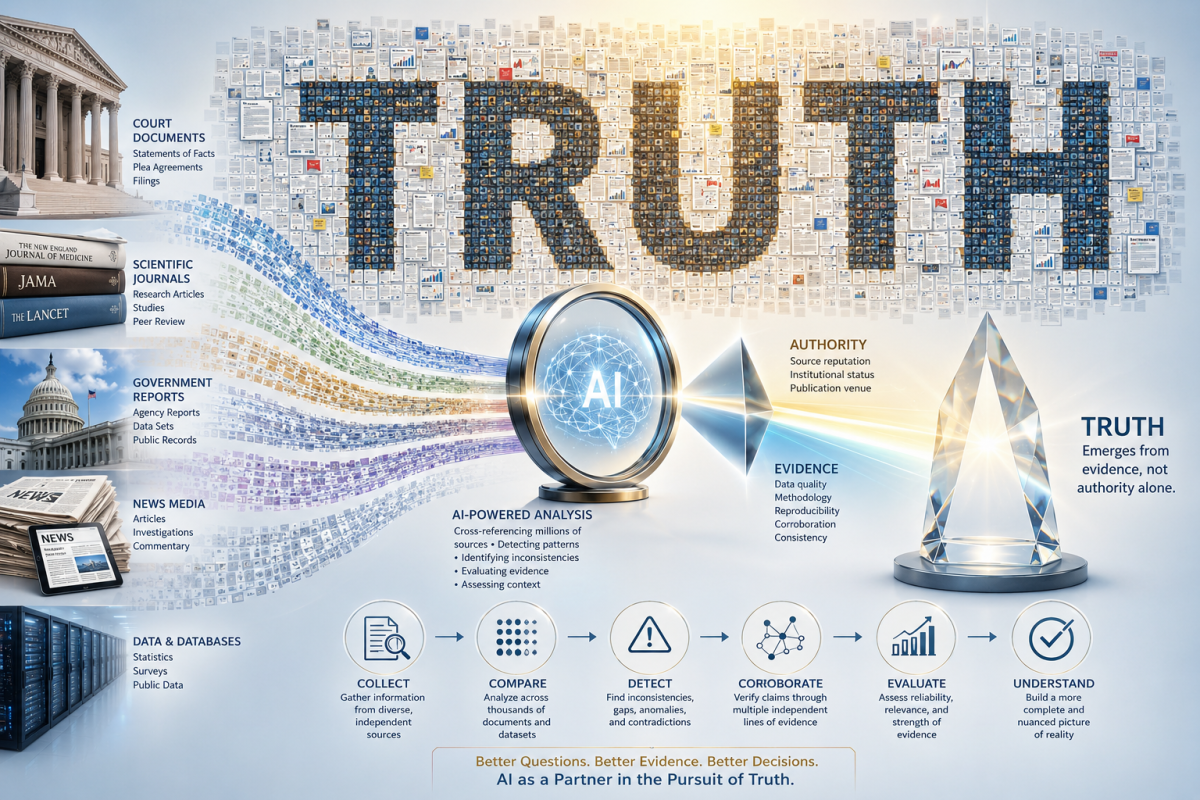
🤖📚 As artificial intelligence becomes more deeply integrated into daily life, a new challenge is emerging that goes far beyond concerns about chatbots making mistakes or generating false information. The real issue may not be AI hallucinations at all, but rather society’s growing tendency to treat information from authoritative institutions as unquestionable truth.
AI systems learn from vast collections of data sourced from governments, courts, universities, research journals, media organizations, and regulatory agencies. Because these sources are generally considered trustworthy, AI models naturally assign greater weight to them. Yet history repeatedly demonstrates that authority and truth are not always identical. Court filings often present only one side of a legal dispute. Scientific studies have occasionally been retracted after influencing policy and public opinion. Government reports may reflect institutional priorities rather than complete reality.
The danger is not that AI will invent entirely new narratives, but that it may amplify existing narratives without understanding their limitations, omissions, or biases. An AI system can accurately summarize a document while still reproducing an incomplete version of events. In doing so, it may unintentionally reinforce assumptions that deserve further scrutiny rather than acceptance.
This challenge highlights an important shift in how society must think about knowledge itself. For centuries, humans have relied on trusted institutions as shortcuts for determining credibility because no individual can independently verify every claim. Artificial intelligence now forces us to reconsider that approach. If machines simply repeat what authoritative sources say, they risk becoming powerful amplifiers of institutional perspectives rather than independent tools for discovering truth.
Ironically, AI may also provide the solution. Future systems could compare millions of documents simultaneously, identify inconsistencies across datasets, detect statistical anomalies, uncover contradictions between sources, and trace claims back to original evidence. Rather than replacing human judgment, AI could become a tool that helps humans evaluate whether accepted narratives are actually supported by facts.
The future of artificial intelligence may therefore depend less on creating smarter machines and more on creating systems capable of questioning assumptions. In an era overwhelmed by information, the greatest value of AI may not be generating answers, but helping society verify which answers deserve to be trusted. 🌍⚖️
AI systems learn from vast collections of data sourced from governments, courts, universities, research journals, media organizations, and regulatory agencies. Because these sources are generally considered trustworthy, AI models naturally assign greater weight to them. Yet history repeatedly demonstrates that authority and truth are not always identical. Court filings often present only one side of a legal dispute. Scientific studies have occasionally been retracted after influencing policy and public opinion. Government reports may reflect institutional priorities rather than complete reality.
The danger is not that AI will invent entirely new narratives, but that it may amplify existing narratives without understanding their limitations, omissions, or biases. An AI system can accurately summarize a document while still reproducing an incomplete version of events. In doing so, it may unintentionally reinforce assumptions that deserve further scrutiny rather than acceptance.
This challenge highlights an important shift in how society must think about knowledge itself. For centuries, humans have relied on trusted institutions as shortcuts for determining credibility because no individual can independently verify every claim. Artificial intelligence now forces us to reconsider that approach. If machines simply repeat what authoritative sources say, they risk becoming powerful amplifiers of institutional perspectives rather than independent tools for discovering truth.
Ironically, AI may also provide the solution. Future systems could compare millions of documents simultaneously, identify inconsistencies across datasets, detect statistical anomalies, uncover contradictions between sources, and trace claims back to original evidence. Rather than replacing human judgment, AI could become a tool that helps humans evaluate whether accepted narratives are actually supported by facts.
The future of artificial intelligence may therefore depend less on creating smarter machines and more on creating systems capable of questioning assumptions. In an era overwhelmed by information, the greatest value of AI may not be generating answers, but helping society verify which answers deserve to be trusted. 🌍⚖️
Tags
news
Comments (0)
Login to post comments
No comments yet
Be the first to share your thoughts about this post.