News
General
42 views
The calculus of AI: Why traditional financial metrics may no longer be enough
Jun 11, 2026
📍 Philadelphia, PA, USA
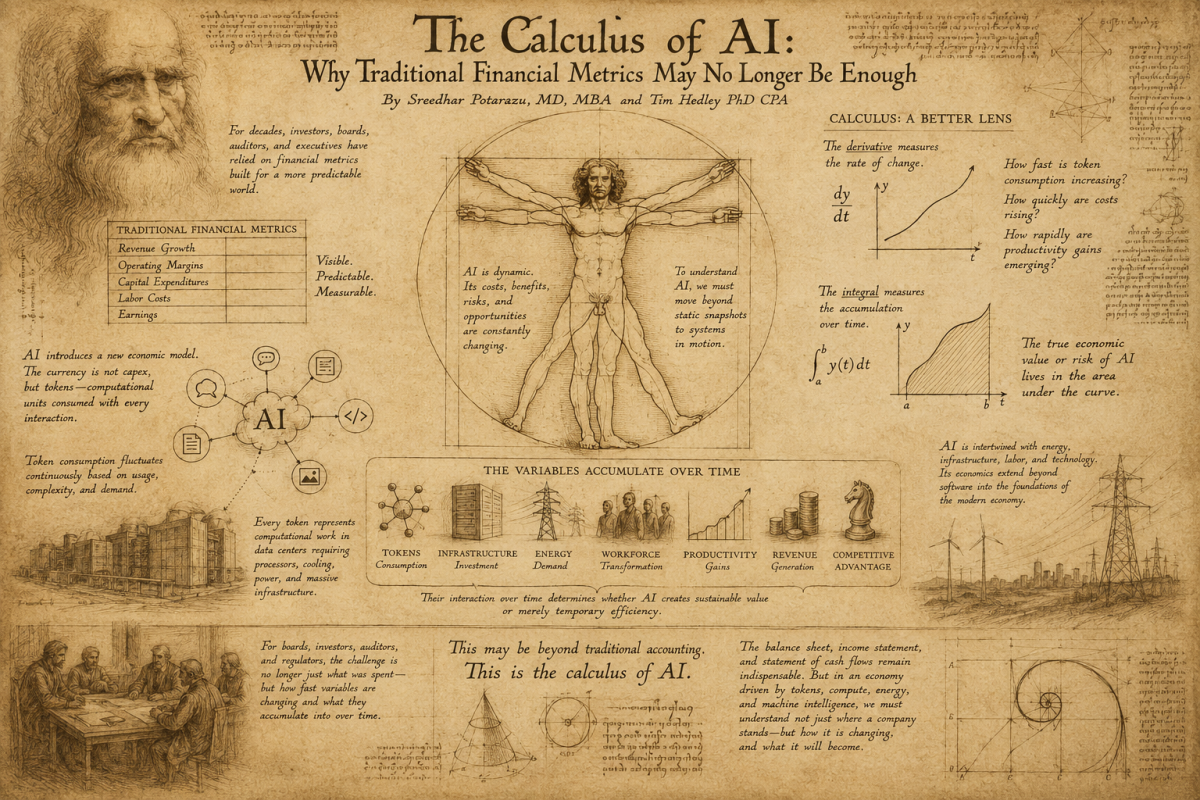
🤖📊 As artificial intelligence rapidly transforms the global economy, experts are warning that traditional financial metrics may no longer be enough to measure the true value—or cost—of modern businesses. A new analysis argues that the AI era is creating an entirely new economic model where success depends not only on revenue, profits, and labor costs, but also on factors such as **token consumption, computing power, energy demand, data-center infrastructure, and machine intelligence**.
For decades, investors and executives relied on familiar indicators such as revenue growth, operating margins, and capital expenditures to evaluate corporate performance. However, AI introduces a different reality. Every interaction with an AI system consumes computational resources known as **tokens**, creating costs that fluctuate continuously based on usage, model complexity, and user demand. Many organizations are investing heavily in AI while still struggling to fully understand the financial impact of those investments.
The challenge extends beyond software. AI relies on massive data centers filled with advanced processors, cooling systems, networking equipment, and enormous amounts of electricity. Technology giants including Microsoft, Google, Amazon, and Meta are spending hundreds of billions of dollars expanding AI infrastructure, while concerns are growing about future energy availability, construction delays, semiconductor supply chains, and long-term operating costs.
The workforce is also evolving. While AI is automating certain tasks, it is simultaneously creating demand for highly skilled professionals such as AI engineers, cybersecurity specialists, data scientists, compliance experts, and governance leaders. Rather than simply eliminating jobs, AI may fundamentally reshape where talent and labor costs are concentrated.
The report suggests that understanding AI-powered companies now requires a completely different mindset. Instead of focusing only on static financial statements, investors must examine how rapidly AI-related variables are changing over time and how those changes accumulate into long-term competitive advantages or risks. In many ways, evaluating AI businesses is becoming less about traditional accounting and more about understanding continuous change, growth, and adaptation.
As artificial intelligence becomes deeply embedded in every industry, experts believe the companies that succeed will be those capable of managing not only technology itself, but also the complex economics of compute power, infrastructure, energy, talent, and innovation. The AI revolution may not just change how businesses operate—it could fundamentally redefine how business value is measured in the decades ahead. 🚀🌍💡
For decades, investors and executives relied on familiar indicators such as revenue growth, operating margins, and capital expenditures to evaluate corporate performance. However, AI introduces a different reality. Every interaction with an AI system consumes computational resources known as **tokens**, creating costs that fluctuate continuously based on usage, model complexity, and user demand. Many organizations are investing heavily in AI while still struggling to fully understand the financial impact of those investments.
The challenge extends beyond software. AI relies on massive data centers filled with advanced processors, cooling systems, networking equipment, and enormous amounts of electricity. Technology giants including Microsoft, Google, Amazon, and Meta are spending hundreds of billions of dollars expanding AI infrastructure, while concerns are growing about future energy availability, construction delays, semiconductor supply chains, and long-term operating costs.
The workforce is also evolving. While AI is automating certain tasks, it is simultaneously creating demand for highly skilled professionals such as AI engineers, cybersecurity specialists, data scientists, compliance experts, and governance leaders. Rather than simply eliminating jobs, AI may fundamentally reshape where talent and labor costs are concentrated.
The report suggests that understanding AI-powered companies now requires a completely different mindset. Instead of focusing only on static financial statements, investors must examine how rapidly AI-related variables are changing over time and how those changes accumulate into long-term competitive advantages or risks. In many ways, evaluating AI businesses is becoming less about traditional accounting and more about understanding continuous change, growth, and adaptation.
As artificial intelligence becomes deeply embedded in every industry, experts believe the companies that succeed will be those capable of managing not only technology itself, but also the complex economics of compute power, infrastructure, energy, talent, and innovation. The AI revolution may not just change how businesses operate—it could fundamentally redefine how business value is measured in the decades ahead. 🚀🌍💡
Tags
news
Comments (0)
Login to post comments
No comments yet
Be the first to share your thoughts about this post.