News
General
4 views
A buyer’s market for neutrality
Nov 23, 2026
📍 Phliadelphia,PA, USA
# Satish Jha: The Middle Powers Are Not Writing the Rules of the Indo-Pacific
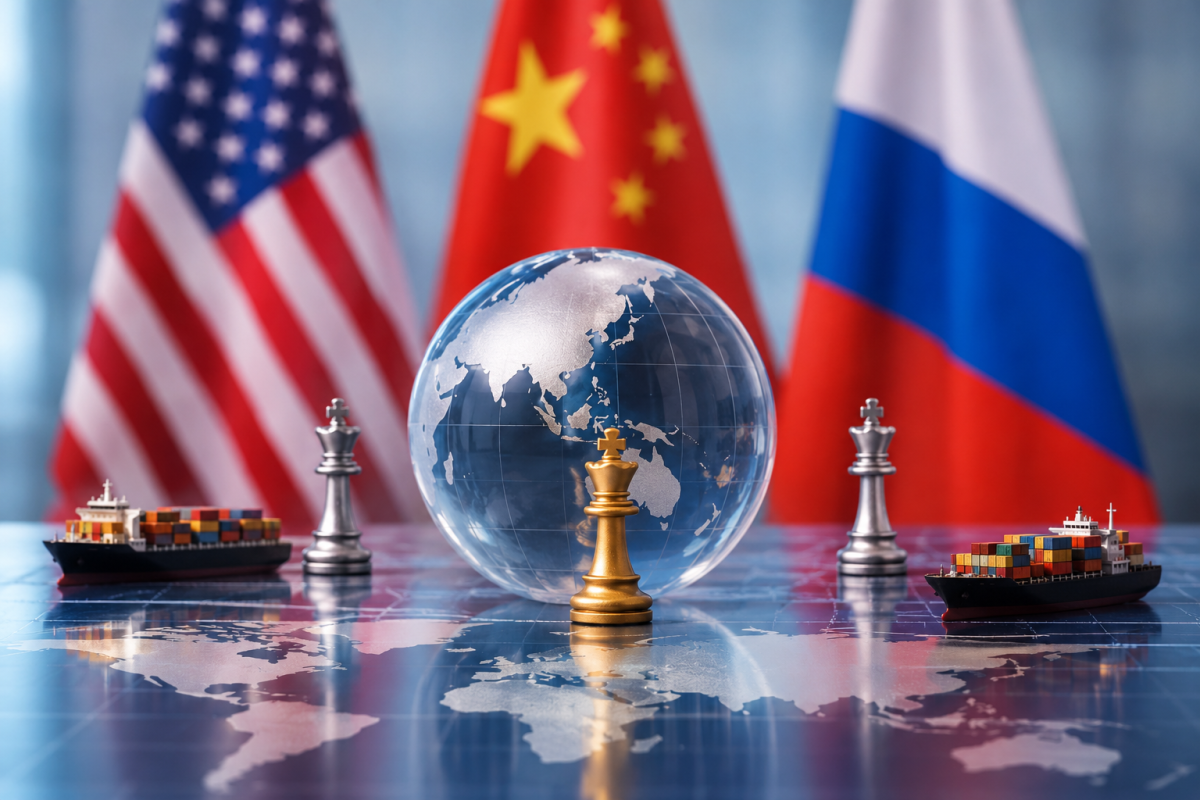
The growing rivalry among the United States, China and Russia is raising questions about who will shape the future of the Indo-Pacific. While regional governments increasingly emphasize strategic independence and diplomatic flexibility, the underlying economic and technological relationships suggest that their ability to influence global rules may be more limited than it appears.
The debate gained attention following the recent diplomatic gatherings in Manila and Shenzhen. More than 20 heads of state and government assembled in Manila for the 49th ASEAN Summit, the 21st East Asia Summit and a revived Quad meeting. Meanwhile, Donald Trump, Xi Jinping and Vladimir Putin met on the sidelines of the 33rd APEC meeting in Shenzhen.
A veteran Indian diplomat has described the contrasting gatherings as evidence of an emerging multipolar order. His assessment argues that a grouping of the United States, China and Russia cannot independently establish international rules, while regional countries are increasingly taking responsibility for shaping their own policies. He also presents India, through Prime Minister Narendra Modi's support for ASEAN centrality and Quad deterrence, as an important independent player.
However, the argument that major powers are unable to dictate outcomes does not necessarily mean that middle powers have gained the ability to establish new rules. The distinction between diplomatic independence and actual bargaining power remains central to understanding the region's changing position.
**Why the major powers cannot reach a lasting agreement**
The United States, China and Russia face significant domestic and international constraints that limit their ability to negotiate major geopolitical compromises.
Washington is dealing with political setbacks and the prospect of a hostile Congress from January 2027. Its ability to reach a settlement over Ukraine also remains limited without the participation of Kyiv and the European Union. Beijing, meanwhile, is unwilling to place its expanding nuclear arsenal under an arms-control framework and continues to face tensions with Washington over technology and semiconductor restrictions.
Russia is also struggling to achieve its objectives in Ukraine while managing the economic demands of a prolonged war.
Domestic pressures further complicate the positions of all three leaders. Xi Jinping faces a property-sector downturn, local-government debt and persistent youth unemployment. Reducing state support for industrial development could place additional pressure on China's economic and political system.
Vladimir Putin's economy has become heavily dependent on military expenditure, making a sudden transition to peace potentially difficult to manage. Trump, meanwhile, faces an electorate increasingly tired of overseas conflicts and concerned about the cost of everyday goods.
These circumstances make substantial concessions politically difficult. Unlike the Yalta Conference, where wartime allies negotiated the postwar division of influence, the Shenzhen meeting brought together competing powers without a shared victory or a common strategic foundation. The comparison with a modern Yalta therefore overlooks the fundamental differences between the two situations.
**The limits of middle-power diplomacy**
The inability of major powers to establish international rules does not automatically give smaller and middle-sized countries the influence to replace them.
During the Cold War, non-aligned countries had considerable bargaining value because Washington and Moscow competed to secure their support. Governments that could shift between the two blocs were able to negotiate industrial assistance, food supplies and security commitments.
The current situation is different. Many Indo-Pacific governments now seek economic and diplomatic relationships with both Washington and Beijing while avoiding exclusive commitments. This approach can protect individual national interests, but when adopted widely, it reduces the bargaining value of each country.
When multiple governments offer similar strategic flexibility, major powers have less reason to provide expensive guarantees or extensive market access. Instead, they can negotiate specific arrangements involving ports, critical minerals, trade and investment without securing long-term political alignment.
The result is a competitive environment in which middle powers may receive selective benefits but struggle to establish broader rules governing international relations.
Indonesia and the Philippines illustrate two different approaches. Indonesia's restrictions on nickel exports have encouraged domestic processing and helped the country secure industrial investment. The Philippines, under President Ferdinand Marcos Jr., has strengthened its security relationship with the United States.
Both cases demonstrate that countries can exercise influence when they possess strategically important resources or are willing to make clearer commitments. However, they do not necessarily represent the broader approach adopted by most regional governments.
**India's strategic position and industrial limitations**
India's position in the region also highlights the tension between strategic flexibility and meaningful influence.
The country's support for ASEAN centrality and its participation in the Quad provide opportunities to engage with multiple partners. However, combining a policy of multi-alignment with stronger security deterrence raises questions about how much risk India and other partners are prepared to share during an actual crisis.
The Quad can strengthen maritime cooperation and information-sharing, but without binding security commitments, its ability to deter a major power remains limited.
India also faces an industrial challenge. According to figures cited from NITI Aayog, the country's share of global manufacturing value increased from approximately 1.5% in 1995 to 3.2% in 2023. China's share, by comparison, reached nearly 32%.
This gap highlights the difference between diplomatic importance and economic leverage. India may attract international attention because of its size, strategic location and growing economy, but developing the industrial capacity necessary to influence global supply chains remains a long-term task.
ASEAN's diplomatic achievements should not be dismissed. Maintaining regional peace and preventing major conflicts are important accomplishments. However, avoiding confrontation is different from establishing enforceable international rules.
**The weakening of international enforcement mechanisms**
The region's ability to create and enforce common rules is also constrained by weaknesses in the existing global institutional system.
The World Trade Organization's Appellate Body has been unable to hear appeals since 2019. China has also rejected the South China Sea arbitration ruling, while recent Indo-Pacific economic frameworks have offered limited enforceable guarantees of market access.
As a result, international governance is increasingly shaped by bilateral negotiations, regional power balances and security arrangements rather than universally enforceable legal mechanisms.
In practice, compliance can depend on naval protection, local military capabilities and the financial risks associated with transporting goods through disputed waterways.
**Supply chains reveal the real distribution of power**
While regional governments discuss economic resilience and reducing dependence on China, many Southeast Asian industries remain closely connected to Chinese manufacturing networks.
A solar panel or electric-vehicle battery assembled in Vietnam or Malaysia may still depend on Chinese supplies of processed rare-earth materials, battery components, industrial machinery and other critical inputs.
Chinese companies have also expanded manufacturing operations across Southeast Asia, often using local subsidiaries, investment and engineering expertise. Products can then be assembled and certified in the region before being exported to markets such as the United States and Europe.
This means that some of the supply-chain diversification described as a move away from China may actually represent an extension of Chinese industrial networks into neighboring economies.
The United States has attempted to address this issue through trade restrictions. In July 2025, Trump announced tariffs of 20% on Vietnamese goods and 40% on products determined to have been transshipped through Vietnam.
However, tariffs primarily target the declared origin of goods. They cannot automatically prevent Chinese-owned factories from establishing legitimate manufacturing operations in Vietnam and qualifying for Vietnamese origin certification.
Consequently, supply-chain diversification may be more visible in trade statistics than in the underlying ownership and production structure.
**Financial networks are also becoming more diversified**
Changes in international financial arrangements provide another example of how countries are adjusting their relationships with major powers.
Russia has increasingly moved trade onto financial channels that bypass Western correspondent banking networks, using the Chinese yuan and, in transactions with India, the Indian rupee.
Across ASEAN, central banks have also been developing arrangements that allow trade settlements in local currencies.
These developments do not necessarily represent an organized effort to replace the U.S. dollar. Instead, they reflect a gradual effort to create alternative payment channels that can provide flexibility during periods of geopolitical or financial disruption.
The financial position of the United States also matters. Growing federal debt-service costs, questions about the government's capacity to finance additional commitments and competition over domestic industrial subsidies may constrain the resources Washington is willing to devote to securing international partnerships.
**Technology is becoming the most decisive dividing line**
Unlike goods and financial transactions, digital infrastructure is much harder to separate across competing geopolitical systems.
Subsea cables, satellite networks, cloud-computing infrastructure, telecommunications systems and artificial intelligence standards increasingly determine how countries connect to the global economy.
Researchers Henry Farrell and Abraham Newman have highlighted how control over critical international networks can become a source of geopolitical influence and economic pressure.
Once a country's telecommunications infrastructure, payment systems and data centers become dependent on a particular technology ecosystem, its ability to maintain independent relationships with competing powers can become significantly restricted.
This is where the experience of Abu Dhabi-based AI company G42 becomes particularly relevant. When Washington raised concerns about the company's connections to Chinese suppliers, CEO Peng Xiao explained that the company could not work with both sides. G42 subsequently sold its investments in China and began removing Chinese hardware from its systems.
In April 2024, Microsoft announced a $1.5 billion investment in G42 following an arrangement involving the U.S. government. The development illustrates how technological partnerships can require a much clearer geopolitical choice than trade or financial relationships.
A similar pattern is visible in the Gulf's investment activities. In January 2025, Abu Dhabi's MGX, backed by sovereign wealth fund Mubadala and G42, joined OpenAI, SoftBank and Oracle as an equity partner in the Stargate artificial intelligence infrastructure venture announced by Trump.
The Gulf continues to maintain important economic relationships with China while relying on the United States for security. However, its participation in major American AI infrastructure projects demonstrates that technological choices can create strategic commitments that are difficult to reverse.
**The challenge facing India and other middle powers**
For middle powers to regain meaningful bargaining strength, they need either to develop capabilities that major powers cannot easily replace or to negotiate collectively rather than individually.
The first option requires industrial depth, advanced manufacturing and control over strategically important resources. India has significant potential but has yet to close the manufacturing gap with China.
The second requires regional governments to coordinate their negotiations and establish common conditions for economic and strategic partnerships. Such cooperation could prevent major powers from negotiating separately with individual countries and securing more favorable terms.
Both approaches demand long-term commitment. Yet the strategy of multi-alignment often emphasizes retaining the freedom to avoid exclusive obligations.
This creates a contradiction: policies that protect each country individually may weaken the collective bargaining position of middle powers when adopted by the entire region.
The same challenge extends beyond India to Indonesia, the Philippines and other Southeast Asian countries.
**Where the next set of rules will be written**
The argument that major powers are losing their ability to dictate international outcomes contains an important insight. However, the assumption that middle powers are automatically gaining the authority to establish new rules is less convincing.
The real decisions shaping the Indo-Pacific may increasingly emerge through agreements involving submarine cable routes, international payment systems, cloud contracts, telecommunications networks and semiconductor supply chains.
These arrangements may appear technical or commercial when negotiated individually. Together, however, they can determine a country's long-term strategic alignment and its dependence on particular powers.
The challenge for India and its regional partners is therefore not simply to maintain diplomatic flexibility. It is to develop the industrial capacity and collective negotiating strength needed to turn that flexibility into lasting influence.
The major powers may be struggling to write the rules, but the middle powers have not yet demonstrated that they can do so either. Much of the region's future will depend on who controls the infrastructure connecting its economies, financial systems and digital networks.
Tags
news
Comments (0)
Login to post comments
No comments yet
Be the first to share your thoughts about this post.