News
General
5 views
$89,000 humanoid robot takes a walk in NYC park to learn human behavior
Nov 03, 2026
📍 Phliadelphia,PA, USA
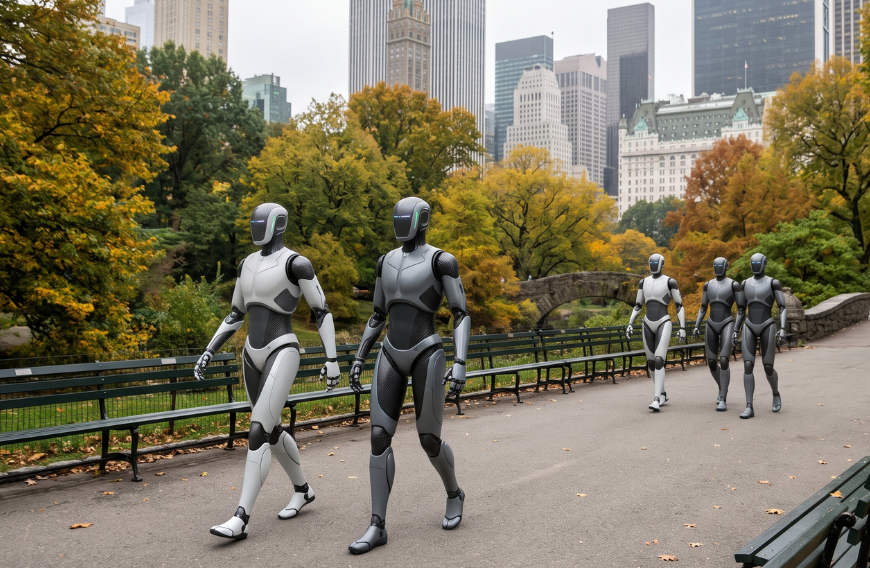
# $89,000 Humanoid Robot Sings and Dances With Visitors at Brooklyn Bridge Park
A life-size humanoid robot developed by California-based technology company Faraday Future drew attention at Brooklyn Bridge Park over the weekend, entertaining visitors as it moved through the waterfront space between the Brooklyn and Manhattan bridges.
Priced at approximately $89,000, the robot sang to children, danced with strangers and posed for photographs against the Manhattan skyline. Visitors stopped to interact with the machine, including a group of around 12 women visiting from Argentina who gathered for pictures.
The public outing was designed to expose the robot to everyday human interactions and help developers evaluate its movement, navigation and social engagement capabilities. The company hopes that advances in these areas could eventually support applications in child care, education and companionship.
## Remote-controlled demonstration tests human interaction
According to the New York Post, Faraday Future Chief Technology Officer Hong Rao operated the robot remotely using a small handheld controller. The demonstration therefore offered an opportunity to observe human responses to a humanoid machine in a public setting, rather than proving that it could independently perform all the actions on display.
Developers have suggested that humanoid robots could eventually serve as babysitters, teachers or companions. However, these applications remain prospective, and the robot would need to demonstrate reliable performance and appropriate safety measures before being entrusted with children or other vulnerable users.
Real-world demonstrations can help engineers assess how robots navigate crowds, respond to people and handle changing surroundings. Such testing is particularly relevant because public spaces are unpredictable and require machines to react safely to unexpected movements and interactions.
## Faraday Future expands its humanoid robot portfolio
Faraday Future introduced five new robot models across nine configurations in September, expanding its reported portfolio to 11 models and 24 products. According to figures cited in the report, the full-size FF Futurist Standard humanoid robot is priced at approximately $89,900, while the more advanced Futurist Ultra model costs around $129,900.
The company has also outlined plans to expand its robotics manufacturing operations in the United States. Its production schedules and commercial ambitions, however, remain dependent on implementation and further development.
The growing range of models reflects the broader technology industry's interest in humanoid machines that can move through human environments and potentially assist with everyday activities. Companies are exploring how such robots might eventually be used in homes, schools, workplaces and public-facing services.
## Safety and autonomy remain major challenges
The demonstration also highlights an important distinction between a robot that can perform an engaging public display and one that can safely operate without human supervision. Remote control allows an operator to guide movements and respond to situations, while an autonomous robot must independently interpret its surroundings and make appropriate decisions.
Introducing humanoid machines into settings involving children would require extensive testing of their ability to recognize hazards, respond to unpredictable behavior and avoid causing harm. Privacy, accountability and the handling of personal information would also need careful consideration.
Brooklyn Bridge Park has previously hosted humanoid robots interacting with children. Footage from March showed a Unitree G1 robot playing with children at the same location, illustrating the growing visibility of such machines in everyday public life.
At the same time, concerns about potential misuse have emerged. German police reportedly opened an investigation into two teenagers over allegations that they controlled a robot that groped a 16-year-old girl and livestreamed the incident on social media. The allegations underscore the importance of safeguards governing how robots are operated and how they interact with people.
As companies continue developing life-size machines intended to assist humans, their commercial success will depend not only on technical performance but also on reliability, safety, responsible deployment and public trust. Faraday Future's Brooklyn demonstration offers a glimpse of this emerging technology, but the prospect of humanoid robots becoming dependable caregivers, educators or companions will require substantial further progress.
Tags
news
Comments (0)
Login to post comments
No comments yet
Be the first to share your thoughts about this post.