News
General
5 views
Sharvi Mahajan among top three winners of 2026 3M Young Scientist Challenge
Nov 02, 2026
📍 Phliadelphia,PA, USA
# Indian American Teen Sharvi Mahajan Wins National Recognition for AI-Powered Drowsy Driving Detector
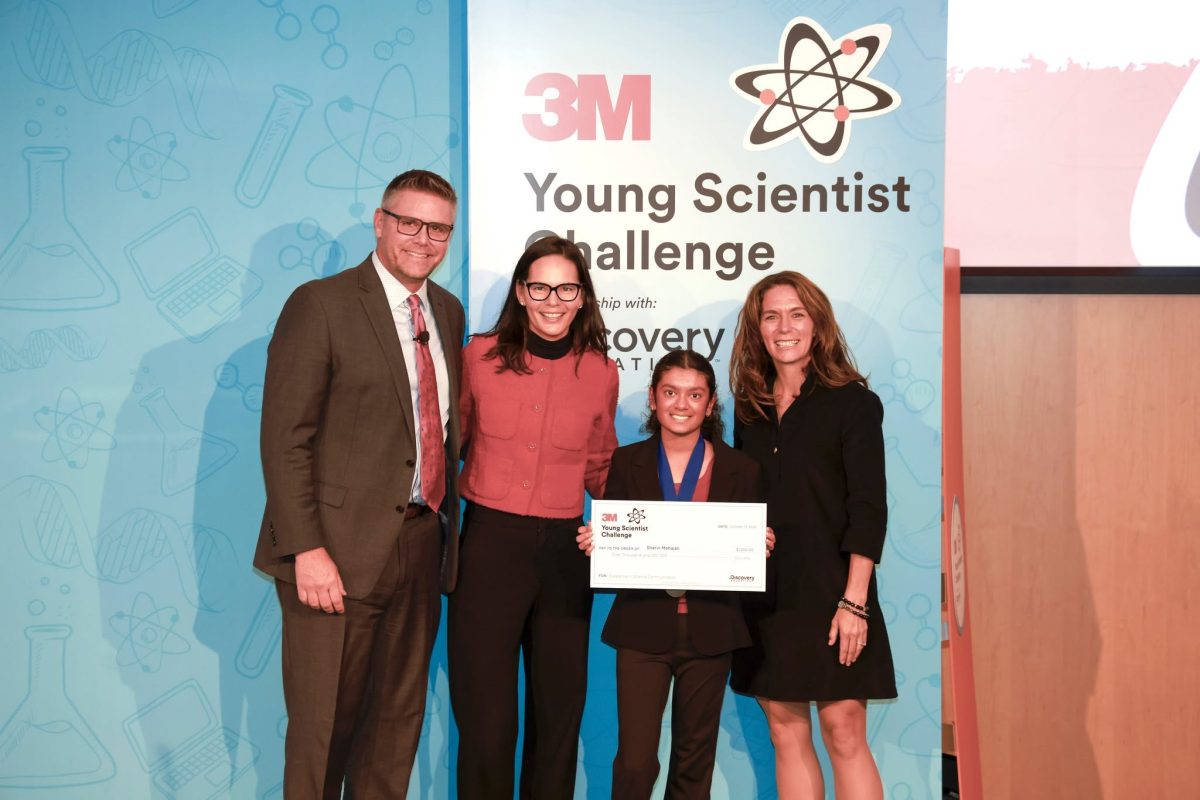
Indian American teenager Sharvi Mahajan of San Diego, California, has earned national recognition after securing third place in the 2026 3M Young Scientist Challenge for developing an artificial intelligence-powered system designed to detect driver fatigue and help prevent road accidents.
The 14-year-old Westview High School student created NeuroDrive Alert, a wearable device that combines brainwave monitoring with machine learning to identify early signs of drowsiness and alert drivers before fatigue compromises their ability to drive safely.
Organized by 3M and Discovery Education, the nationwide competition selected ten finalists whose projects were evaluated on scientific knowledge, creativity and communication skills. Sharvi received a $1,000 prize for her achievement and joined fellow winners and 3M representatives at a special closing bell ceremony at the New York Stock Exchange.
## Turning Neuroscience Into a Road Safety Solution
Sharvi developed NeuroDrive Alert in response to the dangers of drowsy driving, which can impair a driver's attention and reaction time. Rather than relying on visible signs of tiredness, she wanted to create a system capable of identifying potential fatigue earlier.
Her invention uses electroencephalography (EEG), a technique that measures electrical activity in the brain. Machine learning algorithms analyze the recorded signals to identify patterns associated with increasing drowsiness.
The prototype incorporates a wearable baseball cap that captures brain activity and connects with a smartphone application designed to provide immediate warnings when the system detects an elevated risk of fatigue.
By identifying potential warning signs before a driver becomes severely sleepy, the technology aims to provide more time for a safe response. However, further testing and development will be needed to establish its accuracy and effectiveness under real-world driving conditions.
## Mentorship Helped Refine the Prototype
Sharvi's interests in neuroscience and artificial intelligence have played an important role in shaping her project. Her profile for the Young Scientist Challenge identifies the EEG machine as her favorite invention of the past century, reflecting her fascination with the ability to measure subtle changes in brain activity.
She is also interested in brain-computer interfaces and their potential to help people with physical disabilities communicate and regain mobility.
As one of the competition's finalists, Sharvi received mentorship from Stephanie Owen, an R&D product engineering lab manager in 3M's Transportation and Electronics Business Group. The experience gave her an opportunity to refine her prototype while learning more about practical research and engineering.
Reflecting on her experience, Sharvi encouraged other young innovators to take their ideas seriously and explore their potential.
“There’s a lot you can do when you take an idea seriously and give it a chance,” she said.
## Plans to Improve Accuracy and Usability
Sharvi's achievement is an important milestone, but she intends to continue developing NeuroDrive Alert. According to information shared by her mother, Monali Mahajan, her next steps include expanding real-world testing, improving prediction accuracy and making the wearable more comfortable and practical for everyday use.
Her broader ambition is to develop the prototype into a reliable safety technology that could help reduce fatigue-related accidents and potentially save lives.
Looking ahead, Sharvi hopes to combine her interests in neuroscience and computing through a career as a computational neuroscientist or by launching a startup focused on the intersection of brain science and artificial intelligence.
## Indian American Girls Shine in the Competition
Sharvi's achievement was part of a notable showing by Indian American girls in the 2026 competition. Raji Doshi, 13, of Farmington, Connecticut, won the $25,000 grand prize and the title of America's Top Young Scientist for developing a system designed to address ocean acidification.
Aaisha Asif of Sarasota, Florida, secured second place for her research into environmentally friendly adhesives.
The three students claimed the competition's top honors, showcasing the scientific creativity and ambition of young Indian American innovators.
For Sharvi, a project inspired by a pressing road safety concern has become an opportunity to explore the possibilities of AI and neuroscience. As she continues to refine her invention, her work illustrates how student-led innovation can begin with a practical problem and develop into a promising research initiative.
Tags
news
Comments (0)
Login to post comments
No comments yet
Be the first to share your thoughts about this post.