News
General
7 views
The calm before the reckoning: When AI euphoria, political power, and market reality collide
Nov 02, 2026
📍 Phliadelphia,PA, USA
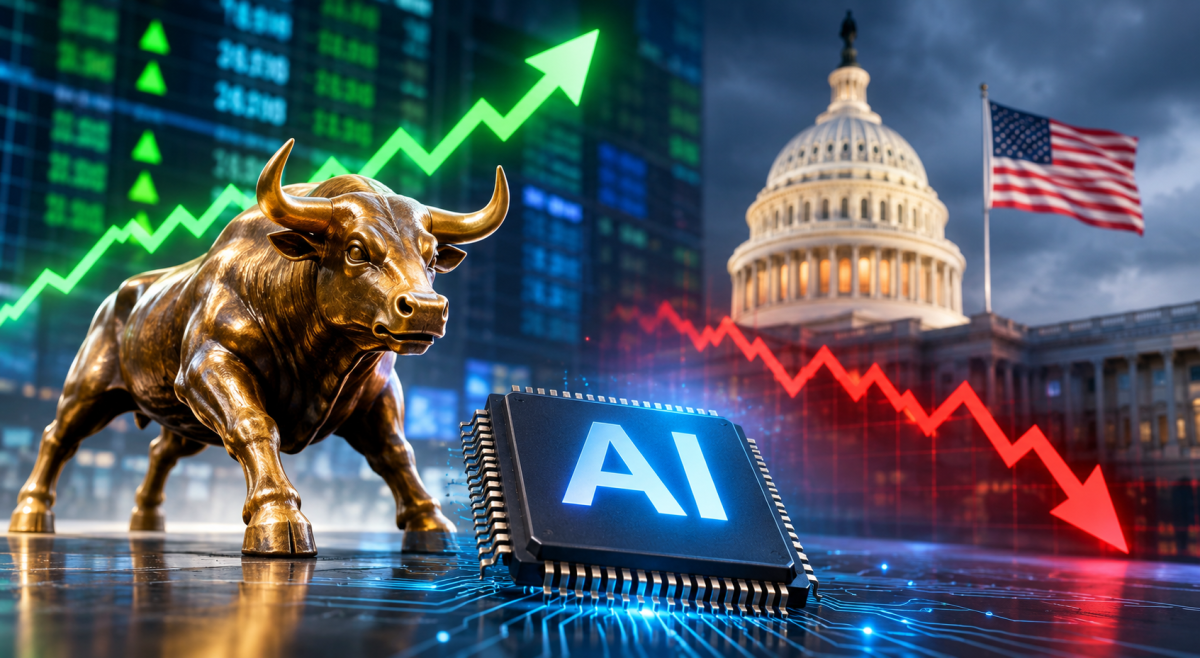
# Is Wall Street’s AI Boom Approaching a Major Reality Check?
For nearly two years, the American stock market has benefited from an extraordinary rally led by the Magnificent Seven: Nvidia, Microsoft, Apple, Amazon, Alphabet, Meta and Tesla. Their rising valuations have lifted major indexes and strengthened perceptions of economic resilience, even as performance across other companies, industries and households has remained uneven.
Yet the rally raises a fundamental question: Is the market reflecting broad-based economic growth, or is it increasingly dependent on concentrated capital, ambitious expectations, political uncertainty and enthusiasm for artificial intelligence?
AI has the potential to become one of the most transformative technologies in history. But the promise of a revolutionary technology does not automatically justify extraordinary stock valuations. Innovation and investment returns are separate matters, and even the most significant technological breakthroughs must ultimately demonstrate their economic value.
## When the AI Narrative Outpaces the Numbers
Nvidia has emerged as a central symbol of the AI boom, while data-center developers, server manufacturers such as Dell and semiconductor companies have benefited from surging demand for computing infrastructure. Businesses have committed enormous sums to chips, servers, power supplies and data centers in anticipation of future AI-driven growth.
However, investment spending alone does not prove that those commitments will generate adequate returns. Investors must consider how quickly customers can turn AI adoption into revenue, whether operating costs will rise faster than earnings, and how electricity, financing, semiconductor and construction expenses will affect profitability.
These questions do not undermine AI's potential. They highlight the importance of financial discipline.
By October 30, 2026, concerns about the economics of the AI buildout had intensified. Intel warned that it did not expect positive cash flow for the year and issued revenue guidance below market expectations, sending its shares down approximately 30%. Dell and other server manufacturers also faced pressure, while Nvidia, AMD and the wider semiconductor sector declined as investors reconsidered the scale and sustainability of AI-related spending.
Amazon's expanding capital expenditure and cash outflows, alongside substantial spending commitments from Alphabet and Meta, added to the debate.
The central question is becoming harder to avoid: When will the enormous investments in AI infrastructure generate sufficient financial returns?
## The Political Dimension of Market Confidence
Since Donald Trump returned to the White House, the interaction between political power, corporate America, financial markets and geopolitical decisions has attracted increased scrutiny. Administration policies involving tariffs, energy, technology, defense and international conflicts can affect asset prices across multiple sectors.
Trump has publicly engaged with major corporate and financial executives, but ordinary investors generally cannot know what may have been discussed privately. That information gap makes transparency and consistent disclosure important.
When policy announcements can move oil prices, defense stocks, technology valuations and currencies, questions about access to information and potential conflicts of interest deserve attention.
Public reports of trading activity ahead of certain major geopolitical and policy announcements have also prompted calls for scrutiny. Such reports do not establish misconduct, and unusual timing alone is not proof of wrongdoing. Nevertheless, regulators and market participants have a legitimate interest in determining whether investors have equal access to material information and whether trading rules are being enforced consistently.
The issue is not whether every political decision is motivated by financial considerations. It is whether the significant market consequences of political decisions create informational advantages that undermine confidence in fair markets.
## Global Capital: A Source of Strength and Vulnerability
American markets have demonstrated considerable resilience despite geopolitical conflict, energy disruptions, inflation concerns and uncertainty in the global economy. Their depth, liquidity and concentration of leading technology companies continue to attract investors seeking exposure to growth.
However, the concentration of capital in a relatively small number of companies can create vulnerabilities when expectations change.
According to the article's cited Reuters report dated October 28, foreign investment had flowed into U.S. mega-cap equities, corporate bonds issued by major cloud-computing companies and power-grid infrastructure supporting AI expansion. The report also highlighted the possibility that these flows could become a source of instability if confidence in the AI investment story weakened.
International capital can support market valuations during periods of optimism, but it can also leave quickly when investors reassess risk. A market that depends heavily on concentrated expectations and mobile institutional investment may appear resilient until sentiment shifts.
This does not mean a reversal is inevitable. It means investors should pay attention to the sustainability of demand, the quality of earnings and the extent to which market performance depends on a limited number of companies.
## War, Energy Prices and the Cost of Capital
Geopolitical tensions add another layer of uncertainty. Supply disruptions and shipping risks can push oil prices higher, benefiting some energy producers while increasing costs for businesses and consumers. Defense companies may receive additional orders, while technology companies face pressure from higher energy costs, financing uncertainty and the possibility of weaker consumer demand.
Cryptocurrencies, including Bitcoin, can also experience sharp declines when investors reduce risk or leveraged positions are liquidated. Capital does not necessarily move through sectors in a predictable sequence, and individual assets can respond differently to the same event.
The more important question is whether geopolitical uncertainty produces temporary sector rotation or a broader reassessment of economic conditions.
Persistently elevated energy prices could prolong inflation. If inflation remains stubborn, interest rates could stay higher for longer, increasing the cost of financing large AI infrastructure projects. Should expected returns fall short, the consequences could extend beyond technology shares to corporate credit, industrial suppliers, employment and the wider economy.
That is one pathway through which a correction in a concentrated sector could develop into a broader market repricing.
## Intelligence Is Not the Same as Financial Wisdom
The debate also reveals a deeper distinction between technological capability and sound economic judgment.
AI systems can process vast quantities of information, identify patterns and assist decision-making. Financial markets, however, remain influenced by human ambition, fear, greed, political incentives, institutional competition and the pressure to avoid missing a major investment trend.
The responsibility for allocating capital still rests with investors, executives and financial institutions. They must determine whether projected returns justify the money being committed.
A strategically important company can still be overvalued. A transformative technology can still attract excessive speculation. And a policy announcement that generates immediate enthusiasm may have long-term consequences that are less favorable than markets initially expect.
The danger arises when a compelling narrative is treated as a substitute for a proven business model.
## Is a Deeper Market Correction Ahead?
A more substantial correction remains a possibility, although neither its timing nor its scale can be reliably predicted. Several developments make the risk worth monitoring.
First, AI infrastructure spending has reached enormous levels, while the long-term returns on much of that investment remain under examination. Second, major indexes have become heavily influenced by a relatively small group of mega-cap companies. Third, foreign institutional capital has become an important source of demand for American technology assets. Fourth, energy prices and geopolitical uncertainty could complicate the inflation and interest-rate outlook. Finally, debt-financed expansion could expose companies to greater financial pressure if projected returns fail to materialize.
The technology selloff on October 30 may prove to be an early warning, but it does not establish that a market collapse has begun.
There are meaningful counterarguments. AI adoption is real, several companies are already generating revenue from AI-related products and services, and the American economy has demonstrated resilience. If productivity gains accelerate and corporate earnings grow sufficiently, a significant portion of current investment may eventually be justified.
The market's next phase will therefore depend on evidence rather than either unqualified optimism or blanket pessimism.
## What Investors Should Monitor
Rather than focusing exclusively on daily movements in the S&P 500, investors can examine several indicators that may offer a clearer picture of the market's underlying health.
One is whether AI-related revenue and earnings growth begin to justify capital expenditure. Another is whether weakness in semiconductors spreads into cloud computing, industrial equipment and corporate credit. Changes in foreign investors' exposure to American technology shares and corporate bonds may also reveal shifts in confidence.
Oil prices and inflation expectations will be important in determining the likely direction of borrowing costs. The performance of the equal-weighted S&P 500 relative to its market-cap-weighted counterpart can help show whether market weakness is broadening beyond the largest companies. Finally, continued scrutiny of market movements surrounding major policy announcements may help identify whether transparency and regulatory concerns require further attention.
Taken together, these indicators can help distinguish a temporary correction from a more extensive repricing of risk.
## A Strong Index Does Not Guarantee a Healthy Market
The concern is not that America lacks economic strength, that AI has no practical value or that every market participant is acting improperly. It is that extraordinary valuations, concentrated capital, political uncertainty, geopolitical risks and massive infrastructure spending have created a combination that deserves careful examination.
Markets can continue rising even as underlying risks accumulate. The temptation to dismiss difficult questions becomes especially strong when prices keep climbing and recent gains appear to validate optimistic expectations.
It is possible that markets will recover quickly, that AI earnings will justify current valuations or that geopolitical tensions will ease. It is equally important to recognize that the distinction between a technology's potential and the price investors pay for it can become a source of significant financial risk.
A major correction is not inevitable, but a rising index alone cannot demonstrate that the danger has passed.
Ultimately, markets demand evidence. Investment narratives can influence prices for extended periods, but cash flow, earnings, debt and economic reality must eventually support the valuations built upon them.
Tags
news
Comments (0)
Login to post comments
No comments yet
Be the first to share your thoughts about this post.