News
General
21 views
From AI hype to real business value: Insights from CAIO Bret Greenstein
Oct 09, 2026
📍 Phliadelphia,PA, USA
Editor’s note: This article is based on insights from a podcast series. The views expressed in the podcast reflect the speakers’ perspectives and do not necessarily represent those of this publication. Readers are encouraged to explore the full podcast for additional context.
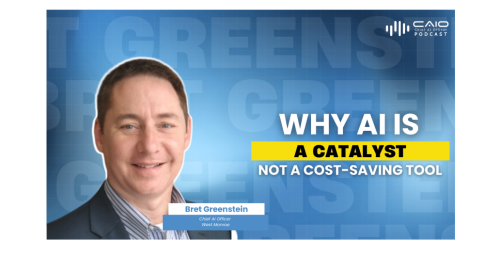
Artificial intelligence is rapidly changing how organizations operate, but many companies continue to struggle to translate their investments in AI into measurable business results. On a recent episode of the *CAIO Connect* podcast, host Sanjay Puri spoke with Bret Greenstein, chief AI officer at West Monroe, about how businesses can move beyond experimentation and use AI to drive meaningful transformation.
Greenstein brings more than three decades of experience in artificial intelligence, data and digital transformation, having worked with organizations including IBM, PwC and Cognizant. During the conversation, he discussed the challenges of AI adoption, the importance of organizational culture, workforce transformation and the growing role of intelligent systems in business operations.
One of Greenstein’s central arguments was that companies often approach AI as a technology experiment rather than a tool for solving business problems. Organizations may invest in new products, establish innovation labs and demonstrate what AI can accomplish without integrating those capabilities into everyday work.
“They will spend money on shiny products. They will set up a lab somewhere and prove that something can be done. And that is not enough to deliver outcomes,” Greenstein said.
He warned that companies can become trapped in endless proofs of concept, focusing on demonstrating technical capabilities instead of changing employee behavior, business processes and decision-making. In his view, successful AI adoption requires organizations to move beyond experimentation and establish clear links between technology and business outcomes.
Organizational culture and leadership are equally important. Greenstein argued that AI initiatives cannot be left exclusively to technical teams because their success depends on understanding how businesses operate and where improvements are needed.
Business leaders must work alongside technology specialists to identify opportunities across functions such as sales, marketing, supply chain management and customer service. When AI projects are connected to specific operational challenges, companies are better positioned to translate technical advances into practical benefits.
To illustrate AI’s capabilities, Greenstein described an experiment in which he asked an AI system to help establish a business by creating marketing, finance, sales and product teams. The system generated specialized sub-agents to handle different responsibilities, demonstrating how quickly AI can organize tasks and produce work.
However, the experience also highlighted a limitation: speed does not automatically translate into meaningful progress. AI systems can generate recommendations and action items rapidly, but people still need to determine which tasks matter, establish priorities and ensure that the resulting work supports the business’s objectives.
Greenstein also compared AI tools with word processors, emphasizing that technology can improve productivity without automatically creating expertise.
“I don’t think giving word processors to people who couldn’t write, make great writers,” he said. He added that providing AI tools to people who do not understand how software serves a business will not automatically produce better software, even though those tools can help knowledgeable professionals work much faster.
The comparison underscores the continuing importance of human judgment and domain expertise. Developers, analysts, designers and other professionals who understand the problems they are trying to solve are likely to benefit most from AI systems that accelerate execution.
Another major theme of the discussion was what Greenstein described as “agentic transformation.” The concept combines traditional business process redesign with a deeper understanding of which activities AI agents can perform effectively.
Rather than automating an entire process without examining its components, organizations should break work into individual activities and assess where AI can contribute. This requires understanding the strengths and weaknesses of AI systems and matching their capabilities to specific tasks and desired outcomes.
As Greenstein explained, businesses need to view work as a series of activities that collectively produce a result, rather than simply treating it as a fixed process to be automated.
This approach could change how employees spend their time. AI systems can assist with reviewing documents, summarizing information, extracting insights and handling repetitive tasks. Employees can then devote more attention to strategic planning, critical thinking, complex decisions and customer relationships.
Such changes require more than deploying new software. Companies must reconsider responsibilities, workflows and the division of work between people and AI systems to achieve sustained improvements in productivity.
Greenstein also challenged the tendency to evaluate AI initiatives primarily through cost reductions. Although lower operating expenses can be one benefit, he argued that an excessive focus on savings can obscure the broader opportunities AI creates.
“People maniacally focus on the wrong thing, and they’re focused on activity instead of on outcomes,” he said.
Instead of measuring success by the number of AI tools introduced or tasks automated, organizations should examine whether the technology improves performance. Relevant measures may include faster decision-making, greater employee productivity, improved customer experiences and the ability to deliver more value with existing resources.
The distinction is important as companies face pressure to demonstrate returns on their AI investments. A project that reduces costs but fails to improve the overall business may offer less value than one that enables employees to serve customers more effectively or make better decisions.
Toward the end of the episode, Puri asked Greenstein what advice he would offer people beginning their roles as chief AI officers. Greenstein’s recommendation was straightforward: listen to the business first.
Understanding the needs of customers, employees and senior leadership should guide decisions about where AI is deployed. Rather than adopting technology simply because it is new or attracts attention, AI leaders should identify the organization’s most important challenges and determine how intelligent systems can help address them.
Greenstein’s broader message is that AI transformation begins with business strategy, not technology alone. Companies that redesign their workflows, involve business leaders and measure meaningful outcomes may be better positioned to turn AI capabilities into lasting improvements.
As AI tools become more capable, the competitive advantage may belong not simply to organizations that adopt them first, but to those that understand how to integrate them into the way work gets done.
Tags
news
Comments (0)
Login to post comments
No comments yet
Be the first to share your thoughts about this post.