News
General
19 views
Biohub launches $1.8 billion AI biology initiative in major science push
Oct 08, 2026
📍 Phliadelphia,PA, USA
# U.S. Government, Google and Meta Join $1.8 Billion AI Biology Initiative
The U.S. government, Google and Meta Platforms are joining forces with Biohub, the nonprofit founded by Mark Zuckerberg and Dr. Priscilla Chan, on a $1.8 billion initiative designed to create large-scale biological datasets for artificial intelligence research.
Known as the Virtual Biology Initiative, the effort aims to give AI systems access to vast amounts of biological information that could help researchers predict how cells and biological systems respond to diseases, environmental changes and potential treatments.
The broader objective is to accelerate biomedical research by allowing scientists to conduct more experiments digitally, potentially reducing the time and resources required for some stages of conventional laboratory research.
The initiative brings together funding and scientific resources from several major organizations. Meta, Google DeepMind and Isomorphic Labs are contributing a combined $300 million, while the U.S. Department of Energy is committing more than $500 million over five years.
The National Institutes of Health is coordinating the federal government's participation and will contribute datasets, repositories and other research resources supported by more than $500 million in previous federal investment. Biohub had separately committed $500 million to the effort.
### Building a “Virtual Cell”
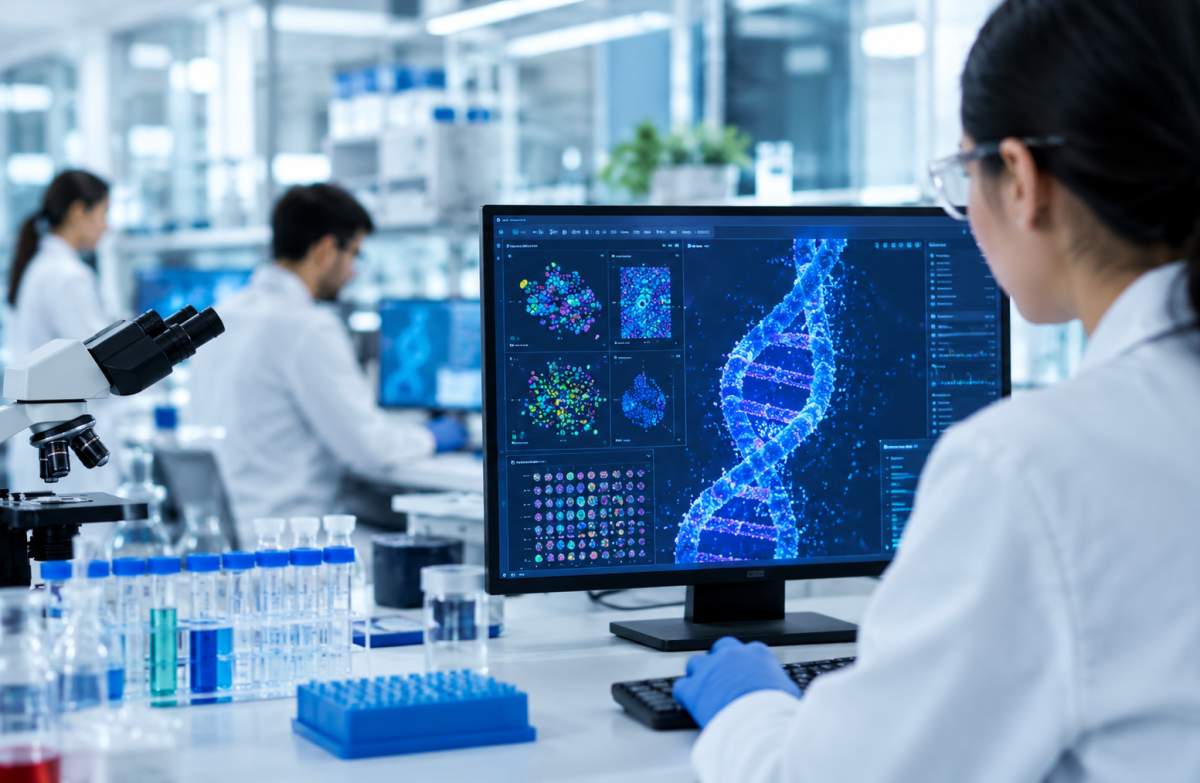
At the center of the project is the concept of a “virtual cell” — a predictive model designed to simulate biological processes and help researchers understand how cells behave under different conditions.
Rather than relying entirely on physical experiments, scientists could eventually use such models to test biological hypotheses digitally and identify promising areas for further laboratory investigation.
Biohub says the project will use technologies including spatial transcriptomics and environmental response screening to generate large volumes of biological data.
The resulting datasets are intended to become an open resource for researchers, although investors participating in the initiative will receive an initial period of exclusive access to some of the information.
Alex Rives, Biohub's head of science, said that a sufficiently accurate predictive model of biology could significantly accelerate scientific discovery by allowing researchers to conduct experiments digitally.
Biohub expects to release its first major dataset within a year and aims to develop functional predictive models within five years, according to Reuters.
The timeline reflects the project's ambition to build not only a large biological database but also AI systems capable of interpreting complex biological relationships.
### AI Moves Deeper Into Biomedical Research
The initiative comes as technology companies and governments increasingly explore artificial intelligence for applications in drug discovery, disease research and clinical development.
AI systems are already being developed to analyze biological data, model potential drug interactions and identify candidates for further research. Companies including OpenAI and Anthropic are also pursuing applications of AI in biology and pharmaceutical research.
The Biohub initiative represents a major expansion of the organization's work at the intersection of biology, computing and artificial intelligence.
Founded in 2016 by Zuckerberg and Chan, Biohub has focused on advancing biomedical research and developing technologies that could improve scientists' ability to understand disease.
The new initiative builds on that mission by placing large-scale biological datasets at the center of AI development.
### Government Infrastructure Meets AI
For the federal government, the partnership also provides an opportunity to connect existing scientific infrastructure with the rapidly expanding field of AI.
The NIH's participation includes its Bio Genesis Mission, which is intended to bring together biomedical datasets, national research infrastructure and scientific programs to support predictive models of human biology.
Creating AI-ready biological datasets at this scale could help researchers work with information that has traditionally been fragmented across laboratories, institutions and scientific repositories.
The approach could eventually allow researchers to test certain biological hypotheses at a scale that would be difficult, expensive or time-consuming to achieve entirely through physical experiments.
However, the effectiveness of these systems will depend heavily on the quality and diversity of the data used to train them. Biological systems are extraordinarily complex, and accurately predicting human biology remains a major scientific challenge.
AI-generated predictions will also need to be tested through conventional laboratory research and, where appropriate, clinical trials before potential treatments can be established as safe and effective.
### Compressing Decades of Research
Biohub and its partners are ultimately seeking to shorten the time required to translate biological knowledge into new discoveries.
By combining large datasets, advanced AI models and high-performance computing, the initiative could give researchers new ways to explore relationships between cells, diseases, environmental conditions and potential treatments.
The project's long-term goal is not simply to produce larger datasets, but to build predictive models capable of helping scientists understand biological systems in greater detail.
If successful, the initiative could demonstrate how AI and large-scale biological data can complement traditional laboratory science, allowing researchers to explore more possibilities before moving promising discoveries into physical experiments.
The effort reflects a broader shift in biomedical research toward computational experimentation, with governments, technology companies and scientific organizations increasingly treating AI as a tool for understanding some of the most complex problems in human biology.
Tags
news
Comments (0)
Login to post comments
No comments yet
Be the first to share your thoughts about this post.