News
General
16 views
‘Of Us’ and ‘For Us’: Humanity under the AI microscope
Oct 08, 2026
📍 Phliadelphia,PA, USA
# AI May Do More Than Solve Problems — It Could Change How We Understand Ourselves
Artificial intelligence is often celebrated for its ability to deliver faster answers, improve productivity and solve increasingly complex problems. But its more profound impact may come from the questions it forces humans to ask about themselves.
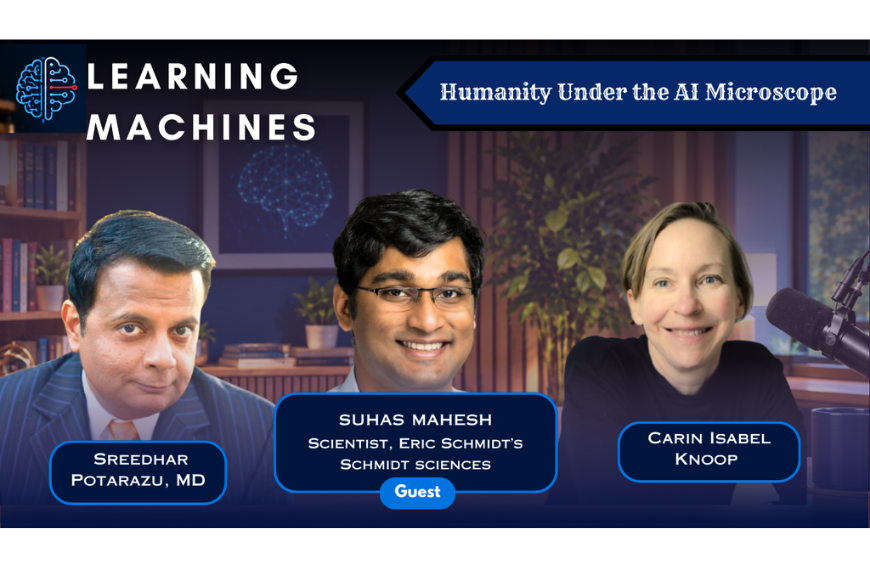
That was a central theme of the latest episode of the “Learning Machines” podcast, which examines how interactions with artificial intelligence can influence the ways people learn, work, lead and understand one another.
The discussion with Dr. Suhas Mahesh, a physicist and scientist at Schmidt Sciences focused on AI and scientific discovery, explored subjects extending well beyond technological performance. The conversation touched on scientific research, human decision-making, the future of work, optimization, intelligence, empathy, judgment and even the meaning of love.
As AI becomes increasingly embedded in personal, professional and social life, it is also challenging people to define concepts they have traditionally taken for granted.
What exactly is intelligence? What makes a decision rational? Can a machine demonstrate empathy, or can it only reproduce the appearance of empathy? And which qualities of human thought and judgment are genuinely unique to people?
Mahesh argues that these questions may be as important as AI’s ability to perform tasks.
“The thing that they tell you AI is going to do is that it is going to make me more productive,” Mahesh said. “But that is truly not what the excitement around AI should be, because this is a new kind of intelligence.”
Rather than focusing only on what AI can accomplish faster, he suggests that people should consider what entirely new questions this different form of intelligence makes possible.
### AI Could Create Its Own “Microscope Moment”
Mahesh uses the history of the microscope to explain why transformative technologies can have consequences far beyond their original purpose.
The earliest microscopes emerged around the beginning of the 17th century as advances in lens-making made it possible to magnify objects beyond the limits of human vision. Their development was primarily an optical achievement, rather than an attempt to establish new scientific disciplines.
Yet the microscope eventually transformed science by revealing a world that had previously been invisible.
In 1665, English scientist Robert Hooke examined thin pieces of cork through a microscope and described the small compartments he called “cells.” Within a few years, Dutch microscopist Antonie van Leeuwenhoek used powerful single-lens microscopes to observe bacteria, protozoa, blood cells and sperm cells.
The discoveries opened an entirely new field of observation. Scientists were no longer simply examining familiar objects more closely; they were encountering structures and living organisms they had never known existed.
The microscope consequently helped create new scientific questions and eventually contributed to fields including microbiology, histology and pathology.
Mahesh sees a similar possibility with AI.
People commonly ask whether AI can accelerate drug discovery, identify new materials, make researchers more productive or help solve difficult scientific problems. But those questions may underestimate what happens when a new form of intelligence can examine enormous amounts of information and identify relationships humans may struggle to see.
AI could potentially reveal patterns, connections and questions that were previously buried inside vast datasets.
### Making Science More Visible
AI may also change science not simply by accelerating research, but by making the research process itself easier to examine.
Scientific publications generally document methods, findings and conclusions. But the published record rarely captures every decision that led to those results, including failed experiments, changing hypotheses, unexpected observations and the reasoning behind individual choices.
Mahesh argues that much of the scientific process remains a “black box.”
The data and final results may be available, but the detailed sequence of decisions and adjustments that produced them often disappears from the formal scientific record.
AI could help create systems in which individual stages of scientific work are recorded, connected and potentially verified.
Such an approach could make research more transparent and allow scientists to understand not only what conclusion was reached, but also how researchers arrived there.
The implications could be significant because science has historically relied heavily on trust. A published paper provides evidence of a researcher's conclusions, but it does not necessarily provide a complete record of the intellectual and experimental journey behind them.
AI could therefore become a tool for examining the process of scientific discovery itself.
### The Human Mind as Another Black Box
The idea also raises a more personal question: If AI makes us more interested in how machines reach conclusions, should it make us more curious about how humans reach ours?
People frequently evaluate decisions based on their outcomes without examining the complex process that produced them.
Consider a disagreement between people with opposing political views. It is easy to focus on whether another person's conclusion is right or wrong. A deeper question might be how that person arrived at the conclusion in the first place — and what processes led us to our own position.
Human judgments emerge from a complicated combination of experience, knowledge, values, assumptions, emotions, intuition and biases. Much of that process is not fully visible even to the person making the decision.
Psychology and behavioral economics have repeatedly shown that people can be influenced by cognitive processes that are difficult to recognize through conscious introspection.
AI may therefore provide an unusual mirror. Studying how machines process information and generate responses could encourage people to examine their own reasoning more carefully.
### Questions AI Asks “For Us” and “Of Us”
One distinction from the discussion is particularly important.
The questions AI asks **“for us”** relate to discovery. They concern what this new form of intelligence might help humanity observe, investigate and understand.
The questions AI asks **“of us”** are different. They force people to reconsider concepts that have traditionally been associated with human beings.
For generations, society has described people as intelligent, rational, thoughtful, empathetic and caring without always agreeing on precise definitions for those qualities.
AI complicates those assumptions.
If an AI system appears empathetic, what separates genuine empathy from an extremely convincing simulation? If a machine produces a rational decision, what exactly makes the decision rational? And if AI demonstrates behavior that looks intelligent, what does intelligence itself actually mean?
These questions are becoming increasingly important as AI systems move into areas that once seemed exclusively human.
Mahesh and his colleagues are examining these issues in forthcoming research, including how concepts such as intelligence and rationality are defined across academic literature.
The absence of universally accepted definitions creates another challenge: comparing humans with machines becomes difficult when researchers cannot fully agree on what they are measuring.
### AI and the Possibility of New Science
The microscope analogy ultimately suggests that AI's greatest contribution may not be its ability to provide better versions of answers humans already know how to seek.
Its deeper contribution could be revealing questions that humans did not previously know how to ask.
Just as microscopy exposed an invisible biological world, AI could expose patterns within scientific knowledge, human behavior and complex datasets that remain difficult for people to perceive.
At the same time, AI may force society to look inward.
The technology is becoming a tool for studying not only the world around us but also the assumptions we hold about intelligence, judgment, empathy, rationality and human uniqueness.
Mahesh argues that some of the most exciting scientific work is open-ended, where researchers encounter genuine surprise rather than simply confirming an expected result.
That idea may offer a useful framework for understanding the current AI transformation.
Humanity is effectively participating in a vast experiment with a technology whose long-term consequences remain uncertain. AI may change how people work and discover, but it may also reveal something about the people creating and using it.
The most important discoveries, therefore, may not be limited to what AI can tell us about the world.
They may also include what AI ultimately teaches us about ourselves.
Tags
news
Comments (0)
Login to post comments
No comments yet
Be the first to share your thoughts about this post.