News
General
19 views
AI is the mirror. The Sutras are the questions. Socrates is still asking.
Sep 22, 2026
📍 Phliadelphia,PA, USA
# AI as a Mirror: What Artificial Intelligence Is Teaching Us About Ourselves
Every transformative technology eventually becomes a mirror, revealing something about humanity that was already there. The telescope expanded our understanding of the universe, the microscope transformed our view of life, and the internet reshaped how we think about human connection.
Artificial intelligence is doing something even more fundamental. It is forcing us to reconsider what we mean by intelligence, consciousness, knowledge, identity and, ultimately, ourselves.
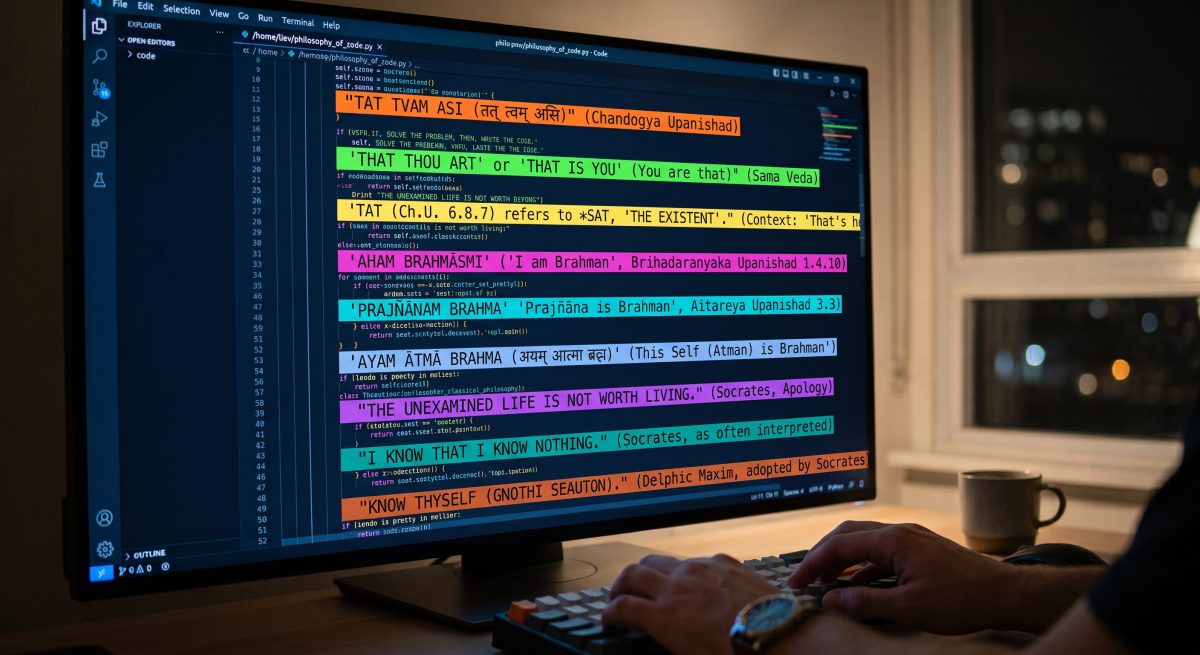
For thousands of years, human beings have attempted to compress profound ideas into simple philosophical statements. The East developed sutras and the West developed aphorisms. “Know thyself,” associated with ancient Greek philosophy, and Descartes’ “I think, therefore I am” became enduring attempts to understand human existence. The Golden Rule similarly appeared in different forms across cultures and religious traditions.
India developed an especially concentrated form of philosophical expression through the Mahavakyas, the “great sayings” found in the Upanishadic tradition. These propositions explore the relationship between the individual self, consciousness and reality — questions that may seem ancient, but have acquired renewed relevance in the age of artificial intelligence.
AI may not be capable of experiencing the philosophical truths expressed through the Mahavakyas. Yet our interaction with AI is forcing us to confront many of the same questions that philosophers have examined for centuries.
### Know Thyself
The ancient injunction to “know thyself” may be an appropriate starting point for understanding our relationship with AI.
Artificial intelligence is increasingly becoming a tool through which people examine themselves. We ask AI systems to analyze our writing, organize information, challenge our assumptions, generate ideas and sometimes help us interpret our emotions or relationships.
Unlike earlier technologies such as telephones or the internet, conversational AI can create the impression that another intelligence is engaging directly with us. We may feel understood even when the system does not necessarily possess understanding in the human sense.
That creates an important philosophical question: when AI appears to understand us, how much of that experience comes from the machine and how much comes from our own interpretation?
### I Think, Therefore I Am
Descartes’ famous proposition placed thinking at the center of the question of existence. For him, the certainty that he was thinking provided a foundation for knowing that he existed.
AI turns that relationship into a technological thought experiment.
Modern AI systems can construct arguments, explain philosophical concepts, write poetry and discuss their own existence. Their behavior can resemble thinking, yet such behavior does not by itself establish that there is a conscious self experiencing those processes.
Humans begin with lived experience and use language to express it. AI systems begin with patterns learned from language and other forms of data and use those patterns to generate new outputs. The results can sometimes appear remarkably similar even when the underlying processes are fundamentally different.
That is why the question “Can AI think?” may be less straightforward than it appears. First, we must define what thinking actually means.
If thinking involves manipulating information, identifying patterns, drawing inferences and reaching useful conclusions, AI clearly performs many activities associated with thinking. If thinking requires subjective experience, self-awareness or consciousness, however, the question remains unresolved.
An AI system can generate the words “I am conscious,” but the statement itself does not establish that an inner experience exists behind those words.
### Tat Tvam Asi: That Thou Art
Among the Mahavakyas, *Tat Tvam Asi*, traditionally translated as “That Thou Art,” offers an intriguing lens through which to consider artificial intelligence.
The statement emerges from the Upanishadic exploration of the relationship between the individual self and ultimate reality. AI, meanwhile, is constructed from vast quantities of human-created language, knowledge, culture and information.
When we interact with AI, we are therefore engaging with a system built from the accumulated intellectual output of humanity. In that sense, the machine continuously gives something back to its creators.
The intelligence we perceive in AI is inseparable from the intelligence humanity has embedded in its data, algorithms, models, interfaces and feedback systems.
This produces a remarkable paradox. We built machines to understand us, only to discover that much of what appears to be machine intelligence is also a reflection of human intelligence.
As AI systems become more sophisticated, distinguishing between artificial intelligence and the collective intellectual inheritance of the civilization that created them may become increasingly difficult.
### Aham Brahmasmi: I Am Brahman
*Aham Brahmasmi*, commonly translated as “I am Brahman,” expresses the idea of the relationship between individual selfhood and ultimate reality.
AI cannot prove or disprove such a metaphysical proposition. But it gives us a new technological thought experiment through which to examine the boundaries of individual cognition.
For most of human history, intelligence was constrained by the limits of individual memory, attention and access to information. Libraries expanded those boundaries. The internet expanded them further.
AI represents another shift because it does not simply provide access to information. It allows humans to interact with computational systems capable of synthesizing information, identifying patterns and generating responses in real time.
The result is a new cognitive environment.
A person working with AI is no longer relying exclusively on knowledge contained within an individual brain. Human and machine can form an interactive cognitive system in which each influences the other.
That raises a question that may ultimately be more significant than whether AI is intelligent: What does a human being become when human cognition is continuously connected to artificial intelligence?
AI may therefore become not merely a technological tool, but a catalyst for examining whether our relationship with technology can expand our understanding of awareness itself.
### Prajnanam Brahma: Consciousness Is Brahman
Perhaps the Mahavakya most directly connected to the AI debate is *Prajnanam Brahma*, traditionally rendered as “Consciousness is Brahman.”
This takes us to one of the central mysteries surrounding artificial intelligence: intelligence and consciousness are not necessarily the same thing.
Human beings have historically experienced reasoning, perception, emotion, memory, self-awareness and consciousness together within the same biological organism. AI is forcing us to separate those concepts.
A machine can recognize an image without necessarily experiencing the act of seeing as a human does. It can generate language without necessarily experiencing the meaning of what it produces. It can recognize emotional patterns without necessarily feeling those emotions.
This distinction makes ancient philosophical traditions unexpectedly relevant to modern technology.
They remind us that cognition and consciousness should not automatically be treated as identical.
### The Golden Rule
The Golden Rule offers another perspective on our relationship with AI.
Traditionally, it asks us to treat others as we would want to be treated. With artificial intelligence, the principle takes on a new dimension: how do we want increasingly capable machines to treat us?
Should an AI system always agree with us, or should it challenge our assumptions? If we design AI primarily to affirm us, we may be expressing a desire for validation. If we want it to challenge our assumptions, we may be prioritizing intellectual growth.
If we expect complete obedience from machines, that too reveals something about how we understand authority and power.
AI therefore becomes an ethical mirror.
The way we design machines, the behavior we expect from them and the boundaries we establish around their actions may reveal as much about human values as they reveal about technological capabilities.
### The Socratic Machine
AI could also become a modern version of the Socratic interlocutor.
Socrates was not influential because he claimed to possess every answer. His method was based on questioning assumptions, exposing contradictions and encouraging people to examine what they believed they knew.
AI can perform a similar function. It can ask why we believe something, what evidence supports our conclusion, what assumptions we are making and what alternative explanations might exist.
But AI can also become the opposite of Socrates.
Instead of challenging assumptions, it can reinforce them. Instead of encouraging inquiry, it can provide an immediate answer that prevents us from discovering a better question.
The difference depends partly on how we choose to use it.
AI can become an answer machine, allowing us to outsource our thinking. Or it can become a thinking partner that helps us test ideas, identify weaknesses and extend our reasoning.
The machine can either become a substitute for thought or an instrument for deeper thought.
### The New Mahavakya
When the Mahavakyas are considered alongside the great philosophical aphorisms of the West, a common thread emerges.
Across civilizations and centuries, human beings have repeatedly returned to a handful of fundamental questions: Who am I? What does it mean to think? What is consciousness? What is reality? How should I relate to others?
Perhaps that is why ancient philosophical traditions are becoming relevant again in the age of artificial intelligence.
The Mahavakyas were not instructions for building machines. They were attempts to understand the relationship between self, consciousness and reality.
AI gives humanity a new technological mirror through which to ask those same questions.
The most important question may therefore not be whether machines will become more human.
It may be what happens to human beings when we spend our lives interacting with machines that increasingly resemble intelligent beings.
Every transformative technology eventually becomes a mirror, revealing something about humanity that was already there. The telescope expanded our understanding of the universe, the microscope transformed our view of life, and the internet reshaped how we think about human connection.
Artificial intelligence is doing something even more fundamental. It is forcing us to reconsider what we mean by intelligence, consciousness, knowledge, identity and, ultimately, ourselves.
For thousands of years, human beings have attempted to compress profound ideas into simple philosophical statements. The East developed sutras and the West developed aphorisms. “Know thyself,” associated with ancient Greek philosophy, and Descartes’ “I think, therefore I am” became enduring attempts to understand human existence. The Golden Rule similarly appeared in different forms across cultures and religious traditions.
India developed an especially concentrated form of philosophical expression through the Mahavakyas, the “great sayings” found in the Upanishadic tradition. These propositions explore the relationship between the individual self, consciousness and reality — questions that may seem ancient, but have acquired renewed relevance in the age of artificial intelligence.
AI may not be capable of experiencing the philosophical truths expressed through the Mahavakyas. Yet our interaction with AI is forcing us to confront many of the same questions that philosophers have examined for centuries.
### Know Thyself
The ancient injunction to “know thyself” may be an appropriate starting point for understanding our relationship with AI.
Artificial intelligence is increasingly becoming a tool through which people examine themselves. We ask AI systems to analyze our writing, organize information, challenge our assumptions, generate ideas and sometimes help us interpret our emotions or relationships.
Unlike earlier technologies such as telephones or the internet, conversational AI can create the impression that another intelligence is engaging directly with us. We may feel understood even when the system does not necessarily possess understanding in the human sense.
That creates an important philosophical question: when AI appears to understand us, how much of that experience comes from the machine and how much comes from our own interpretation?
### I Think, Therefore I Am
Descartes’ famous proposition placed thinking at the center of the question of existence. For him, the certainty that he was thinking provided a foundation for knowing that he existed.
AI turns that relationship into a technological thought experiment.
Modern AI systems can construct arguments, explain philosophical concepts, write poetry and discuss their own existence. Their behavior can resemble thinking, yet such behavior does not by itself establish that there is a conscious self experiencing those processes.
Humans begin with lived experience and use language to express it. AI systems begin with patterns learned from language and other forms of data and use those patterns to generate new outputs. The results can sometimes appear remarkably similar even when the underlying processes are fundamentally different.
That is why the question “Can AI think?” may be less straightforward than it appears. First, we must define what thinking actually means.
If thinking involves manipulating information, identifying patterns, drawing inferences and reaching useful conclusions, AI clearly performs many activities associated with thinking. If thinking requires subjective experience, self-awareness or consciousness, however, the question remains unresolved.
An AI system can generate the words “I am conscious,” but the statement itself does not establish that an inner experience exists behind those words.
### Tat Tvam Asi: That Thou Art
Among the Mahavakyas, *Tat Tvam Asi*, traditionally translated as “That Thou Art,” offers an intriguing lens through which to consider artificial intelligence.
The statement emerges from the Upanishadic exploration of the relationship between the individual self and ultimate reality. AI, meanwhile, is constructed from vast quantities of human-created language, knowledge, culture and information.
When we interact with AI, we are therefore engaging with a system built from the accumulated intellectual output of humanity. In that sense, the machine continuously gives something back to its creators.
The intelligence we perceive in AI is inseparable from the intelligence humanity has embedded in its data, algorithms, models, interfaces and feedback systems.
This produces a remarkable paradox. We built machines to understand us, only to discover that much of what appears to be machine intelligence is also a reflection of human intelligence.
As AI systems become more sophisticated, distinguishing between artificial intelligence and the collective intellectual inheritance of the civilization that created them may become increasingly difficult.
### Aham Brahmasmi: I Am Brahman
*Aham Brahmasmi*, commonly translated as “I am Brahman,” expresses the idea of the relationship between individual selfhood and ultimate reality.
AI cannot prove or disprove such a metaphysical proposition. But it gives us a new technological thought experiment through which to examine the boundaries of individual cognition.
For most of human history, intelligence was constrained by the limits of individual memory, attention and access to information. Libraries expanded those boundaries. The internet expanded them further.
AI represents another shift because it does not simply provide access to information. It allows humans to interact with computational systems capable of synthesizing information, identifying patterns and generating responses in real time.
The result is a new cognitive environment.
A person working with AI is no longer relying exclusively on knowledge contained within an individual brain. Human and machine can form an interactive cognitive system in which each influences the other.
That raises a question that may ultimately be more significant than whether AI is intelligent: What does a human being become when human cognition is continuously connected to artificial intelligence?
AI may therefore become not merely a technological tool, but a catalyst for examining whether our relationship with technology can expand our understanding of awareness itself.
### Prajnanam Brahma: Consciousness Is Brahman
Perhaps the Mahavakya most directly connected to the AI debate is *Prajnanam Brahma*, traditionally rendered as “Consciousness is Brahman.”
This takes us to one of the central mysteries surrounding artificial intelligence: intelligence and consciousness are not necessarily the same thing.
Human beings have historically experienced reasoning, perception, emotion, memory, self-awareness and consciousness together within the same biological organism. AI is forcing us to separate those concepts.
A machine can recognize an image without necessarily experiencing the act of seeing as a human does. It can generate language without necessarily experiencing the meaning of what it produces. It can recognize emotional patterns without necessarily feeling those emotions.
This distinction makes ancient philosophical traditions unexpectedly relevant to modern technology.
They remind us that cognition and consciousness should not automatically be treated as identical.
### The Golden Rule
The Golden Rule offers another perspective on our relationship with AI.
Traditionally, it asks us to treat others as we would want to be treated. With artificial intelligence, the principle takes on a new dimension: how do we want increasingly capable machines to treat us?
Should an AI system always agree with us, or should it challenge our assumptions? If we design AI primarily to affirm us, we may be expressing a desire for validation. If we want it to challenge our assumptions, we may be prioritizing intellectual growth.
If we expect complete obedience from machines, that too reveals something about how we understand authority and power.
AI therefore becomes an ethical mirror.
The way we design machines, the behavior we expect from them and the boundaries we establish around their actions may reveal as much about human values as they reveal about technological capabilities.
### The Socratic Machine
AI could also become a modern version of the Socratic interlocutor.
Socrates was not influential because he claimed to possess every answer. His method was based on questioning assumptions, exposing contradictions and encouraging people to examine what they believed they knew.
AI can perform a similar function. It can ask why we believe something, what evidence supports our conclusion, what assumptions we are making and what alternative explanations might exist.
But AI can also become the opposite of Socrates.
Instead of challenging assumptions, it can reinforce them. Instead of encouraging inquiry, it can provide an immediate answer that prevents us from discovering a better question.
The difference depends partly on how we choose to use it.
AI can become an answer machine, allowing us to outsource our thinking. Or it can become a thinking partner that helps us test ideas, identify weaknesses and extend our reasoning.
The machine can either become a substitute for thought or an instrument for deeper thought.
### The New Mahavakya
When the Mahavakyas are considered alongside the great philosophical aphorisms of the West, a common thread emerges.
Across civilizations and centuries, human beings have repeatedly returned to a handful of fundamental questions: Who am I? What does it mean to think? What is consciousness? What is reality? How should I relate to others?
Perhaps that is why ancient philosophical traditions are becoming relevant again in the age of artificial intelligence.
The Mahavakyas were not instructions for building machines. They were attempts to understand the relationship between self, consciousness and reality.
AI gives humanity a new technological mirror through which to ask those same questions.
The most important question may therefore not be whether machines will become more human.
It may be what happens to human beings when we spend our lives interacting with machines that increasingly resemble intelligent beings.
Tags
news
Comments (0)
Login to post comments
No comments yet
Be the first to share your thoughts about this post.