News
General
6 views
‘Go back to India’ to online threats: South Asian Americans face rising hostility as anti-immigrant sentiment grows
Sep 07, 2026
📍 Phliadelphia,PA, USA
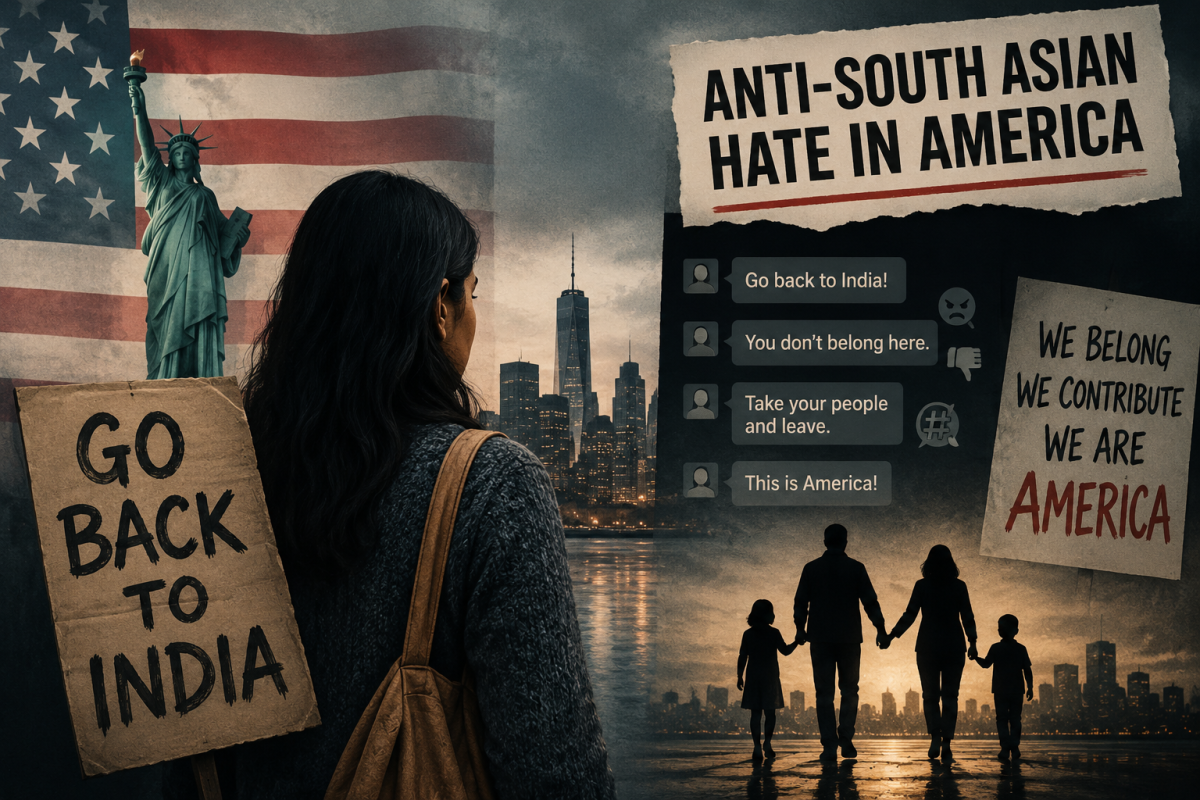
# Anti-South Asian Hate Rises Across U.S. as Indian Americans Face Growing Anxiety
For Sarika Kapoor, a routine shopping trip with her two young children at a Target store in Irving, Texas, became an unsettling reminder that discrimination can appear in ordinary places.
Kapoor, who has lived in Irving for years, said a man in the store stopped near her family, looked at her and made a remark comparing the noise of her children to India.
She said she initially did not fully process what he had said. But after recognizing the nature of the comment, Kapoor decided to finish her shopping and leave rather than risk a confrontation while she was with her children.
The incident left her particularly troubled because the store was part of her everyday life and a place she visited regularly.
For Kapoor, the episode was not simply about one offensive comment. It raised a broader concern about whether immigrants and people of color can feel fully secure in communities they have spent years calling home.
Her experience comes as South Asian Americans report increasing concerns about discrimination, harassment and anti-immigrant rhetoric across the United States.
A new report from Stop AAPI Hate, an organization that tracks discrimination and hate targeting Asian American and Pacific Islander communities, provides new data on the issue.
The report, titled “The State of Anti-South Asian Hate,” examines developments between 2023 and 2025 and documents what the organization describes as a growing climate of hostility toward South Asian communities.
According to the report, the use of anti-South Asian slurs online increased by 109% between January 2023 and December 2025.
The report also found that 55% of South Asian adults surveyed said they or another AAPI community member they knew had been affected by changing immigration policies or anti-immigrant sentiment.
The findings come at a time when immigration has become one of the most politically charged issues in the United States.
Political debates over immigration, work visas and border enforcement have increasingly spilled into online spaces, where South Asians say they are sometimes portrayed through stereotypes involving employment, immigration and national identity.
Stop AAPI Hate also reported that South Asians were disproportionately targeted in online threats of violence directed at Asian communities.
Between August 2024 and December 2025, South Asians accounted for 71% of the anti-Asian threats of violence tracked in online spaces associated with targeted violence, according to the report.
The figures highlight a shift in the nature of anti-Asian hostility, with South Asians increasingly becoming targets of rhetoric that combines racial stereotypes with hostility toward immigration.
Some Indian Americans interviewed in Texas, New York and Chicago said they believe the political environment surrounding immigration during President Donald Trump's second administration has contributed to a heightened sense of vulnerability.
The experiences vary considerably.
For some, hostility takes the form of an offensive comment or racial slur.
For others, it can involve harassment at workplaces, businesses or public events.
A South Asian woman in California, who requested anonymity, described an incident at a fitness facility in which she said an employee refused to allow her to enroll in a class and directed racial and ethnic insults at her.
She said the experience left her feeling humiliated and unwelcome in a place where she had expected to participate like any other customer.
Such accounts challenge the assumption that economic success necessarily protects immigrant communities from discrimination.
Indian Americans have become a significant presence in technology, medicine, finance, entrepreneurship and other professional sectors.
Many have built businesses, purchased homes and established families across communities that are among the country's most prosperous metropolitan areas.
Yet economic advancement does not necessarily eliminate racial prejudice.
The Stop AAPI Hate report specifically points to the emergence of narratives portraying South Asian immigrants as an “invasion” or “replacement” and connecting Indian immigration with competition for American jobs.
The debate surrounding H-1B visas has been particularly vulnerable to such rhetoric.
Indian nationals make up a large share of the H-1B workforce, making Indian professionals especially visible in arguments about skilled immigration.
The report says debates surrounding the visa program have been accompanied by increases in anti-South Asian slurs online.
One Indian woman in Texas also described an incident at her workplace in which she said a customer became verbally abusive and used racial and misogynistic insults while expressing support for deporting Indians.
Such encounters demonstrate how political language can move beyond social media and become part of interactions between strangers, customers and workers.
Concerns are also being shaped by immigration enforcement.
According to the Stop AAPI Hate report, South Asians experienced a substantial increase in immigration enforcement during the second Trump administration.
The report says South Asians represented the Asian regional group with the highest number of ICE arrests, detentions and deportations during the period it examined.
It also estimates that deportations involving South Asian nationals were approximately 14 times higher than during the previous administration.
For immigrants who have spent decades building lives in the United States, immigration enforcement can create uncertainty even when they have established deep ties to the country.
The case of Venkata Vasamsetty illustrates that anxiety.
Vasamsetty, a longtime U.S. resident and green-card holder, was arrested and detained by U.S. Immigration and Customs Enforcement.
An immigration judge later ruled in her favor, concluding that the Department of Homeland Security had not met the legal burden necessary to establish that she had abandoned her permanent resident status.
The case illustrates how immigration uncertainty can affect people who have lived in the United States for many years.
For foreign-born professionals on temporary work visas, the situation can be even more complicated.
Mahesh Shetty, an H-1B worker in Seattle, said he and his wife ultimately decided to return to India after he lost his job at a global company.
Rather than remain in the United States while searching for another position and dealing with uncertainty surrounding his immigration status, the couple chose to leave.
Shetty said the combination of layoffs, online hostility toward Indian H-1B workers and uncertainty over immigration rules had become too difficult to manage.
His experience reflects a broader dilemma faced by some skilled immigrants: whether the professional opportunities available in the United States outweigh the uncertainty associated with temporary immigration status.
The concern extends beyond employment.
South Asian communities have also faced highly visible incidents of political and cultural hostility.
In June 2026, a video showing a man tearing an Indian flag outside Frisco City Hall circulated widely online, accompanied by reports of anti-India slogans from people nearby.
The incident followed an earlier demonstration outside the Karya Siddhi Hanuman Temple in Frisco, where members of a far-right group displayed anti-India and anti-immigrant messages.
For Indian Americans, such incidents can be particularly disturbing because places such as temples, community centers and city halls are normally viewed as shared public spaces.
The growing visibility of anti-South Asian rhetoric raises questions about how communities can respond without allowing isolated incidents to define broader social relationships.
The United States remains a country where immigrants and their descendants have played a major role in economic growth, innovation and community development.
Indian Americans, in particular, have established a substantial presence across business, technology, medicine, academia and public life.
But integration is not measured only by income, professional status or home ownership.
It is also measured by whether people feel safe participating in ordinary public life without expecting hostility because of their ethnicity or immigration background.
That is why incidents such as the one described by Kapoor can have an impact far beyond the moment itself.
A comment made by a stranger may last only a few seconds, but the anxiety it creates can remain with a family long after they leave the store.
For parents, that concern can become even more personal when children are present.
The challenge for American communities is therefore not simply to respond to overt acts of hate but also to confront the normalization of racial stereotypes and anti-immigrant language.
The findings from Stop AAPI Hate suggest that South Asian Americans are increasingly experiencing that tension in both digital and physical spaces.
Whether the current trend represents a temporary reaction to political polarization or a deeper change in social attitudes remains an open question.
What is clear is that the community's concerns can no longer be reduced to isolated incidents.
For immigrants who have spent decades building careers, businesses, friendships and families in the United States, the central issue is increasingly one of belonging.
The question is not only whether they can succeed in America.
It is whether they can continue to see America as home—and feel that their neighbors see them as part of it.
For Sarika Kapoor, a routine shopping trip with her two young children at a Target store in Irving, Texas, became an unsettling reminder that discrimination can appear in ordinary places.
Kapoor, who has lived in Irving for years, said a man in the store stopped near her family, looked at her and made a remark comparing the noise of her children to India.
She said she initially did not fully process what he had said. But after recognizing the nature of the comment, Kapoor decided to finish her shopping and leave rather than risk a confrontation while she was with her children.
The incident left her particularly troubled because the store was part of her everyday life and a place she visited regularly.
For Kapoor, the episode was not simply about one offensive comment. It raised a broader concern about whether immigrants and people of color can feel fully secure in communities they have spent years calling home.
Her experience comes as South Asian Americans report increasing concerns about discrimination, harassment and anti-immigrant rhetoric across the United States.
A new report from Stop AAPI Hate, an organization that tracks discrimination and hate targeting Asian American and Pacific Islander communities, provides new data on the issue.
The report, titled “The State of Anti-South Asian Hate,” examines developments between 2023 and 2025 and documents what the organization describes as a growing climate of hostility toward South Asian communities.
According to the report, the use of anti-South Asian slurs online increased by 109% between January 2023 and December 2025.
The report also found that 55% of South Asian adults surveyed said they or another AAPI community member they knew had been affected by changing immigration policies or anti-immigrant sentiment.
The findings come at a time when immigration has become one of the most politically charged issues in the United States.
Political debates over immigration, work visas and border enforcement have increasingly spilled into online spaces, where South Asians say they are sometimes portrayed through stereotypes involving employment, immigration and national identity.
Stop AAPI Hate also reported that South Asians were disproportionately targeted in online threats of violence directed at Asian communities.
Between August 2024 and December 2025, South Asians accounted for 71% of the anti-Asian threats of violence tracked in online spaces associated with targeted violence, according to the report.
The figures highlight a shift in the nature of anti-Asian hostility, with South Asians increasingly becoming targets of rhetoric that combines racial stereotypes with hostility toward immigration.
Some Indian Americans interviewed in Texas, New York and Chicago said they believe the political environment surrounding immigration during President Donald Trump's second administration has contributed to a heightened sense of vulnerability.
The experiences vary considerably.
For some, hostility takes the form of an offensive comment or racial slur.
For others, it can involve harassment at workplaces, businesses or public events.
A South Asian woman in California, who requested anonymity, described an incident at a fitness facility in which she said an employee refused to allow her to enroll in a class and directed racial and ethnic insults at her.
She said the experience left her feeling humiliated and unwelcome in a place where she had expected to participate like any other customer.
Such accounts challenge the assumption that economic success necessarily protects immigrant communities from discrimination.
Indian Americans have become a significant presence in technology, medicine, finance, entrepreneurship and other professional sectors.
Many have built businesses, purchased homes and established families across communities that are among the country's most prosperous metropolitan areas.
Yet economic advancement does not necessarily eliminate racial prejudice.
The Stop AAPI Hate report specifically points to the emergence of narratives portraying South Asian immigrants as an “invasion” or “replacement” and connecting Indian immigration with competition for American jobs.
The debate surrounding H-1B visas has been particularly vulnerable to such rhetoric.
Indian nationals make up a large share of the H-1B workforce, making Indian professionals especially visible in arguments about skilled immigration.
The report says debates surrounding the visa program have been accompanied by increases in anti-South Asian slurs online.
One Indian woman in Texas also described an incident at her workplace in which she said a customer became verbally abusive and used racial and misogynistic insults while expressing support for deporting Indians.
Such encounters demonstrate how political language can move beyond social media and become part of interactions between strangers, customers and workers.
Concerns are also being shaped by immigration enforcement.
According to the Stop AAPI Hate report, South Asians experienced a substantial increase in immigration enforcement during the second Trump administration.
The report says South Asians represented the Asian regional group with the highest number of ICE arrests, detentions and deportations during the period it examined.
It also estimates that deportations involving South Asian nationals were approximately 14 times higher than during the previous administration.
For immigrants who have spent decades building lives in the United States, immigration enforcement can create uncertainty even when they have established deep ties to the country.
The case of Venkata Vasamsetty illustrates that anxiety.
Vasamsetty, a longtime U.S. resident and green-card holder, was arrested and detained by U.S. Immigration and Customs Enforcement.
An immigration judge later ruled in her favor, concluding that the Department of Homeland Security had not met the legal burden necessary to establish that she had abandoned her permanent resident status.
The case illustrates how immigration uncertainty can affect people who have lived in the United States for many years.
For foreign-born professionals on temporary work visas, the situation can be even more complicated.
Mahesh Shetty, an H-1B worker in Seattle, said he and his wife ultimately decided to return to India after he lost his job at a global company.
Rather than remain in the United States while searching for another position and dealing with uncertainty surrounding his immigration status, the couple chose to leave.
Shetty said the combination of layoffs, online hostility toward Indian H-1B workers and uncertainty over immigration rules had become too difficult to manage.
His experience reflects a broader dilemma faced by some skilled immigrants: whether the professional opportunities available in the United States outweigh the uncertainty associated with temporary immigration status.
The concern extends beyond employment.
South Asian communities have also faced highly visible incidents of political and cultural hostility.
In June 2026, a video showing a man tearing an Indian flag outside Frisco City Hall circulated widely online, accompanied by reports of anti-India slogans from people nearby.
The incident followed an earlier demonstration outside the Karya Siddhi Hanuman Temple in Frisco, where members of a far-right group displayed anti-India and anti-immigrant messages.
For Indian Americans, such incidents can be particularly disturbing because places such as temples, community centers and city halls are normally viewed as shared public spaces.
The growing visibility of anti-South Asian rhetoric raises questions about how communities can respond without allowing isolated incidents to define broader social relationships.
The United States remains a country where immigrants and their descendants have played a major role in economic growth, innovation and community development.
Indian Americans, in particular, have established a substantial presence across business, technology, medicine, academia and public life.
But integration is not measured only by income, professional status or home ownership.
It is also measured by whether people feel safe participating in ordinary public life without expecting hostility because of their ethnicity or immigration background.
That is why incidents such as the one described by Kapoor can have an impact far beyond the moment itself.
A comment made by a stranger may last only a few seconds, but the anxiety it creates can remain with a family long after they leave the store.
For parents, that concern can become even more personal when children are present.
The challenge for American communities is therefore not simply to respond to overt acts of hate but also to confront the normalization of racial stereotypes and anti-immigrant language.
The findings from Stop AAPI Hate suggest that South Asian Americans are increasingly experiencing that tension in both digital and physical spaces.
Whether the current trend represents a temporary reaction to political polarization or a deeper change in social attitudes remains an open question.
What is clear is that the community's concerns can no longer be reduced to isolated incidents.
For immigrants who have spent decades building careers, businesses, friendships and families in the United States, the central issue is increasingly one of belonging.
The question is not only whether they can succeed in America.
It is whether they can continue to see America as home—and feel that their neighbors see them as part of it.
Tags
news
Comments (0)
Login to post comments
No comments yet
Be the first to share your thoughts about this post.