News
General
7 views
What the number cannot see
Sep 07, 2026
📍 Phliadelphia,PA, USA
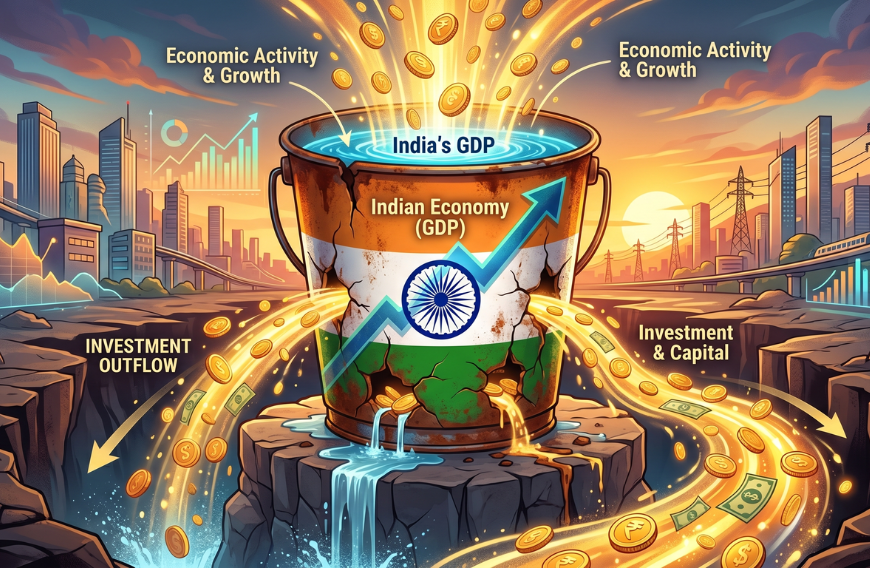
# India’s Growth Story and the Economy That Official Statistics Struggle to See
India’s economic story is often told through numbers: GDP growth, employment, tax collections, investment, consumption and infrastructure spending.
But behind those numbers lies another economy—one that operates largely outside formal records and whose fortunes can be difficult to capture in official statistics.
The tension between these two economies became particularly visible after the government’s 2016 demonetization exercise.
The stated objective was to tackle unaccounted wealth and push more economic activity into the formal banking system.
For millions of small businesses and workers, however, the disruption was immediate.
Street vendors, small retailers, tailors, casual workers and other informal-sector participants often operated without the banking infrastructure, documentation or financial buffers available to larger formal businesses.
When cash became scarce, some businesses survived. Others struggled or disappeared.
Their customers did not necessarily disappear with them.
In many cases, demand simply moved toward businesses that already had bank accounts, tax registrations, digital payment systems and formal records.
That creates an important statistical problem.
When a formal business gains customers previously served by an informal enterprise, official data can record the expansion of the formal business relatively easily.
The closure of the informal business may be much harder to measure.
The result is that formal-sector growth can appear strong even when parts of the informal economy are under severe pressure.
This distinction matters because a country's economic statistics are ultimately intended to describe economic activity and living standards, not merely the portion of activity that is easiest to measure.
India's informal economy has historically accounted for a substantial share of employment and economic activity.
Yet informal businesses are inherently more difficult to track because many operate without detailed invoices, payroll records or standardized financial reporting.
For years, the formal and informal parts of the economy broadly moved together, allowing economists to estimate the performance of the less visible sector.
But several major shocks—including demonetization, the introduction of the Goods and Services Tax and the COVID-19 pandemic—disrupted that relationship.
GST increased the visibility of businesses operating within the formal tax system.
For larger companies, that increased transparency could be absorbed through accounting departments, software and professional advisers.
For very small businesses, compliance could be considerably more demanding.
Some adapted and entered the formal system.
Others reduced their activity, closed their operations or continued working largely through cash-based transactions.
That creates a fundamental challenge for economic measurement: the easier an activity becomes to observe, the more likely it is to appear in the official statistical picture.
The difficulty becomes even more complicated when national accounts are revised.
India introduced a new GDP series in 2026, incorporating a new base year and methodological changes.
The revised calculations changed the estimated size and growth path of the economy.
Growth for 2023-24, for example, was revised from 9.2 percent under the previous series to 7.2 percent under the new methodology.
Revisions are not inherently evidence of bad statistics.
Economic measurement evolves as governments obtain better information, improve methodology and update the structure of the economy.
But revisions can also raise uncomfortable questions about what earlier estimates may have missed.
One particularly important issue is the measurement of prices.
Economists use price deflators to distinguish changes in the value of economic output from changes in the physical quantity of goods and services produced.
This can produce counterintuitive results.
If the prices of goods sold by a manufacturer behave differently from the prices of its inputs, the inflation adjustment can change the appearance of real economic growth.
A negative deflator, therefore, does not automatically mean that the physical goods coming out of factories have become cheaper.
It reflects the relationship between different price movements used in the calculation.
The mathematics can be correct while the interpretation remains complicated.
This is why GDP alone cannot answer every question about how households and businesses are experiencing the economy.
Employment statistics present a similar challenge.
Official data may show unemployment declining while many workers continue to experience unstable or low-paid employment.
Whether someone is classified as employed can depend on the definition used and the reference period covered by the survey.
A person who worked for a limited period may be counted as employed even if that work generated very little income.
Unpaid assistance in a family business can also enter employment statistics under certain definitions.
Consequently, a decline in unemployment does not necessarily mean that household incomes, job security or working conditions have improved proportionately.
This distinction is especially important in an economy where informal and self-employed work remain significant.
A statistical system can establish that someone worked without necessarily establishing whether that work provided a sustainable livelihood.
The same limitation applies to economic transfers.
When money moves through a bank account, the financial transaction becomes visible.
But the transaction alone does not explain the economic circumstances behind it.
Similarly, infrastructure statistics can record kilometers of roads, bridges constructed or industrial capacity created.
They do not automatically reveal whether businesses in a particular district are receiving enough orders, whether trucks are carrying full loads or whether households have sufficient purchasing power.
Businesses often develop their own informal economic indicators.
Companies may watch two-wheeler sales, diesel consumption, freight movement, tractor purchases, rural credit and local demand to determine whether economic activity is genuinely strengthening.
These indicators can sometimes tell a different story from headline economic growth.
That divergence does not automatically mean that official GDP data are wrong.
It does, however, suggest that policymakers should examine a wider range of indicators before drawing conclusions about economic well-being.
International institutions have also raised questions about India's national accounts methodology.
The International Monetary Fund has identified areas where India's statistical system could be strengthened, including aspects of national accounts, price measurement and coverage of the informal economy.
Independent economists have similarly produced alternative estimates that challenge some official assessments of India's economic performance.
Such studies should not automatically be treated as definitive replacements for official statistics.
Economic measurement is complex, and alternative estimates can themselves be challenged on methodological grounds.
But the existence of serious independent research is important because it encourages greater scrutiny of how economic performance is calculated.
The larger issue is not whether India should use official statistics or alternative estimates.
It is whether the statistical system can adequately capture an economy undergoing rapid structural change.
If informal businesses disappear while their customers migrate to formal competitors, the resulting formal-sector expansion may be real.
But it may not tell the complete story about the economic welfare of the households affected.
A closed shop does not necessarily vanish from the economy without consequence.
Its customers may continue spending elsewhere.
Its former workers may find different jobs.
Its owner may become a casual worker.
The economic activity can therefore continue in another form even though a livelihood has been disrupted.
That distinction between aggregate activity and individual welfare is crucial.
GDP can rise while some households become more financially vulnerable.
Employment can increase while the quality of available work deteriorates.
Tax collections can grow while small businesses face higher compliance costs.
Infrastructure can expand while local demand remains weak.
All of these conditions can exist simultaneously.
This is why economic statistics should be viewed as instruments rather than complete descriptions of economic life.
The numbers are essential for policymaking, but the choice of what is measured—and what remains difficult to measure—can influence the story those numbers tell.
India's economic transformation has brought millions of businesses and workers into a more formal financial system.
That transition has benefits, including greater access to credit, improved tax compliance, stronger documentation and potentially better productivity.
But formalization also creates winners and losers, particularly when smaller enterprises lack the resources to absorb the costs of transition.
The policy challenge is therefore not simply to increase the size of the formal economy.
It is to ensure that formalization expands opportunity rather than merely transferring economic activity from one group of businesses to another.
India's policymakers will continue to revise national accounts, improve surveys and refine statistical methods.
Those efforts are necessary.
But the quality of an economic story should ultimately be judged by more than whether the headline number rises.
It should also ask whether workers are earning more, whether small businesses are surviving, whether rural demand is strengthening and whether households can actually afford the lives that economic growth is supposed to make possible.
The official number will continue to define India's economic performance in government documents and international comparisons.
Businesses and households, however, will continue to judge the economy through orders, wages, credit, sales and the ability to make ends meet.
Both forms of measurement matter.
The challenge for India is to ensure that its statistical picture remains broad enough to see not only the economy that produces invoices, tax records and bank transactions, but also the millions of people whose economic lives remain largely outside those systems.
India’s economic story is often told through numbers: GDP growth, employment, tax collections, investment, consumption and infrastructure spending.
But behind those numbers lies another economy—one that operates largely outside formal records and whose fortunes can be difficult to capture in official statistics.
The tension between these two economies became particularly visible after the government’s 2016 demonetization exercise.
The stated objective was to tackle unaccounted wealth and push more economic activity into the formal banking system.
For millions of small businesses and workers, however, the disruption was immediate.
Street vendors, small retailers, tailors, casual workers and other informal-sector participants often operated without the banking infrastructure, documentation or financial buffers available to larger formal businesses.
When cash became scarce, some businesses survived. Others struggled or disappeared.
Their customers did not necessarily disappear with them.
In many cases, demand simply moved toward businesses that already had bank accounts, tax registrations, digital payment systems and formal records.
That creates an important statistical problem.
When a formal business gains customers previously served by an informal enterprise, official data can record the expansion of the formal business relatively easily.
The closure of the informal business may be much harder to measure.
The result is that formal-sector growth can appear strong even when parts of the informal economy are under severe pressure.
This distinction matters because a country's economic statistics are ultimately intended to describe economic activity and living standards, not merely the portion of activity that is easiest to measure.
India's informal economy has historically accounted for a substantial share of employment and economic activity.
Yet informal businesses are inherently more difficult to track because many operate without detailed invoices, payroll records or standardized financial reporting.
For years, the formal and informal parts of the economy broadly moved together, allowing economists to estimate the performance of the less visible sector.
But several major shocks—including demonetization, the introduction of the Goods and Services Tax and the COVID-19 pandemic—disrupted that relationship.
GST increased the visibility of businesses operating within the formal tax system.
For larger companies, that increased transparency could be absorbed through accounting departments, software and professional advisers.
For very small businesses, compliance could be considerably more demanding.
Some adapted and entered the formal system.
Others reduced their activity, closed their operations or continued working largely through cash-based transactions.
That creates a fundamental challenge for economic measurement: the easier an activity becomes to observe, the more likely it is to appear in the official statistical picture.
The difficulty becomes even more complicated when national accounts are revised.
India introduced a new GDP series in 2026, incorporating a new base year and methodological changes.
The revised calculations changed the estimated size and growth path of the economy.
Growth for 2023-24, for example, was revised from 9.2 percent under the previous series to 7.2 percent under the new methodology.
Revisions are not inherently evidence of bad statistics.
Economic measurement evolves as governments obtain better information, improve methodology and update the structure of the economy.
But revisions can also raise uncomfortable questions about what earlier estimates may have missed.
One particularly important issue is the measurement of prices.
Economists use price deflators to distinguish changes in the value of economic output from changes in the physical quantity of goods and services produced.
This can produce counterintuitive results.
If the prices of goods sold by a manufacturer behave differently from the prices of its inputs, the inflation adjustment can change the appearance of real economic growth.
A negative deflator, therefore, does not automatically mean that the physical goods coming out of factories have become cheaper.
It reflects the relationship between different price movements used in the calculation.
The mathematics can be correct while the interpretation remains complicated.
This is why GDP alone cannot answer every question about how households and businesses are experiencing the economy.
Employment statistics present a similar challenge.
Official data may show unemployment declining while many workers continue to experience unstable or low-paid employment.
Whether someone is classified as employed can depend on the definition used and the reference period covered by the survey.
A person who worked for a limited period may be counted as employed even if that work generated very little income.
Unpaid assistance in a family business can also enter employment statistics under certain definitions.
Consequently, a decline in unemployment does not necessarily mean that household incomes, job security or working conditions have improved proportionately.
This distinction is especially important in an economy where informal and self-employed work remain significant.
A statistical system can establish that someone worked without necessarily establishing whether that work provided a sustainable livelihood.
The same limitation applies to economic transfers.
When money moves through a bank account, the financial transaction becomes visible.
But the transaction alone does not explain the economic circumstances behind it.
Similarly, infrastructure statistics can record kilometers of roads, bridges constructed or industrial capacity created.
They do not automatically reveal whether businesses in a particular district are receiving enough orders, whether trucks are carrying full loads or whether households have sufficient purchasing power.
Businesses often develop their own informal economic indicators.
Companies may watch two-wheeler sales, diesel consumption, freight movement, tractor purchases, rural credit and local demand to determine whether economic activity is genuinely strengthening.
These indicators can sometimes tell a different story from headline economic growth.
That divergence does not automatically mean that official GDP data are wrong.
It does, however, suggest that policymakers should examine a wider range of indicators before drawing conclusions about economic well-being.
International institutions have also raised questions about India's national accounts methodology.
The International Monetary Fund has identified areas where India's statistical system could be strengthened, including aspects of national accounts, price measurement and coverage of the informal economy.
Independent economists have similarly produced alternative estimates that challenge some official assessments of India's economic performance.
Such studies should not automatically be treated as definitive replacements for official statistics.
Economic measurement is complex, and alternative estimates can themselves be challenged on methodological grounds.
But the existence of serious independent research is important because it encourages greater scrutiny of how economic performance is calculated.
The larger issue is not whether India should use official statistics or alternative estimates.
It is whether the statistical system can adequately capture an economy undergoing rapid structural change.
If informal businesses disappear while their customers migrate to formal competitors, the resulting formal-sector expansion may be real.
But it may not tell the complete story about the economic welfare of the households affected.
A closed shop does not necessarily vanish from the economy without consequence.
Its customers may continue spending elsewhere.
Its former workers may find different jobs.
Its owner may become a casual worker.
The economic activity can therefore continue in another form even though a livelihood has been disrupted.
That distinction between aggregate activity and individual welfare is crucial.
GDP can rise while some households become more financially vulnerable.
Employment can increase while the quality of available work deteriorates.
Tax collections can grow while small businesses face higher compliance costs.
Infrastructure can expand while local demand remains weak.
All of these conditions can exist simultaneously.
This is why economic statistics should be viewed as instruments rather than complete descriptions of economic life.
The numbers are essential for policymaking, but the choice of what is measured—and what remains difficult to measure—can influence the story those numbers tell.
India's economic transformation has brought millions of businesses and workers into a more formal financial system.
That transition has benefits, including greater access to credit, improved tax compliance, stronger documentation and potentially better productivity.
But formalization also creates winners and losers, particularly when smaller enterprises lack the resources to absorb the costs of transition.
The policy challenge is therefore not simply to increase the size of the formal economy.
It is to ensure that formalization expands opportunity rather than merely transferring economic activity from one group of businesses to another.
India's policymakers will continue to revise national accounts, improve surveys and refine statistical methods.
Those efforts are necessary.
But the quality of an economic story should ultimately be judged by more than whether the headline number rises.
It should also ask whether workers are earning more, whether small businesses are surviving, whether rural demand is strengthening and whether households can actually afford the lives that economic growth is supposed to make possible.
The official number will continue to define India's economic performance in government documents and international comparisons.
Businesses and households, however, will continue to judge the economy through orders, wages, credit, sales and the ability to make ends meet.
Both forms of measurement matter.
The challenge for India is to ensure that its statistical picture remains broad enough to see not only the economy that produces invoices, tax records and bank transactions, but also the millions of people whose economic lives remain largely outside those systems.
Tags
news
Comments (0)
Login to post comments
No comments yet
Be the first to share your thoughts about this post.