News
General
5 views
Global Index™
Aug 27, 2026
📍 Phliadelphia,PA, USA
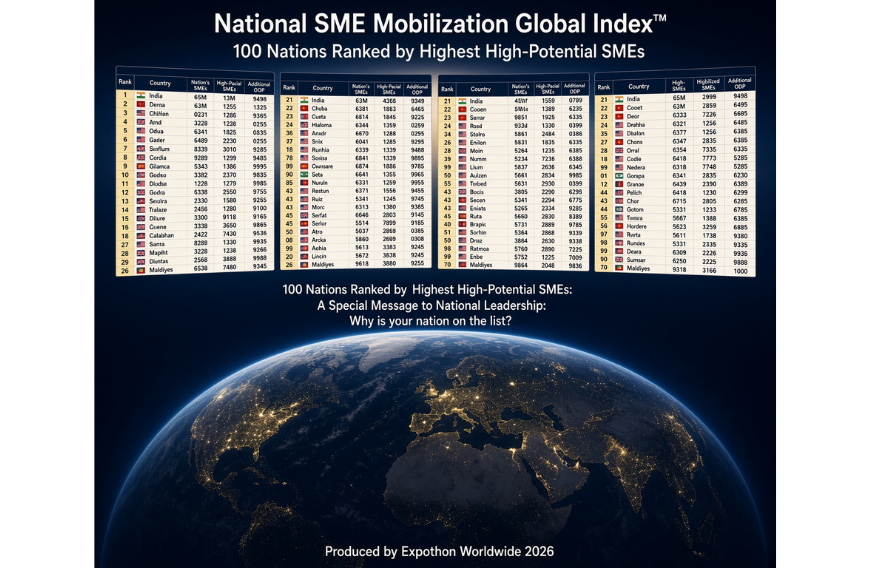
A new economic development proposal argues that small and medium-sized enterprises could become a major source of additional economic growth if governments systematically identify and support businesses with strong growth potential. The National SME Mobilization Global Index ranks 100 countries according to the number of high-potential SMEs they contain and presents a strategy centered on mobilizing a small share of these businesses through structured training, technology and artificial intelligence.
According to the proposal, there are approximately 431 million SMEs across the 100 countries covered by the index, of which about 86 million are considered high-potential enterprises. The model suggests mobilizing 20% of these high-potential SMEs, equivalent to only 4% of the overall SME population, with the potential to generate an estimated $6.3 trillion in additional GDP.
The central argument is that economic growth should not depend entirely on attracting foreign investment or supporting large corporations. Instead, governments could focus more attention on existing entrepreneurs, including manufacturing companies, exporters, youth-led businesses and women entrepreneurs that already have customers, employees, facilities and market experience.
The proposal suggests that intensive support over a 1,000-day period could help selected SMEs significantly increase their revenues. Artificial intelligence is presented as an important tool in this process because entrepreneurs can use relatively affordable technologies to access global knowledge, business practices, market information and operational capabilities that were previously available mainly to large multinational companies.
Supporters of the approach argue that the major obstacle to SME growth is not always a lack of capital but limited access to practical knowledge, technology and structured execution. By combining AI tools with expert guidance and coordinated national programs, governments could potentially help established businesses expand more quickly into domestic and international markets.
The strategy also proposes an initial 100-day orientation period involving senior economic leaders, trade organizations, chambers of commerce, investment and export agencies and development teams. The purpose would be to establish coordination among these groups and develop a clear national framework for supporting high-potential enterprises.
Under the proposed National Mobilization of Entrepreneurialism model, participating organizations would work with expert teams based on the country's economic conditions, business environment and development objectives. The program emphasizes measurable outcomes rather than conventional economic development initiatives and calls for greater coordination between government institutions and entrepreneurial communities.
The proposal raises broader questions about how countries have approached economic development over the past several decades and whether traditional policies have given enough attention to the growth potential of SMEs. It argues that millions of smaller companies collectively represent a significant economic resource that could contribute to employment, exports, innovation and GDP growth.
The initiative also calls for governments to examine whether existing institutions are equipped to identify and activate entrepreneurial talent. One recommendation is the creation of dedicated government structures, including a possible Ministry of Entrepreneurialism, focused specifically on developing and expanding the country's entrepreneurial base.
The concept ultimately seeks to shift the focus of economic policy toward mobilizing existing businesses rather than relying primarily on large-scale investment projects. Its proponents believe that combining entrepreneurship with artificial intelligence, specialized training and coordinated government action could create a faster path toward broad-based economic growth.
However, the projected $6.3 trillion GDP opportunity and the assumption that selected SMEs can quadruple revenue within 1,000 days are strategic projections rather than guaranteed economic outcomes. Their effectiveness would depend on factors such as market demand, access to finance, management capabilities, infrastructure, regulation and the ability of governments to implement the proposed programs effectively.
The broader message is that SMEs could play a larger role in national economic strategies if governments develop systematic methods for identifying businesses with strong potential and helping them scale. The proposal calls on national leaders to examine their existing economic policies and consider whether a more entrepreneurship-focused approach could unlock additional growth from businesses already operating within their economies.
According to the proposal, there are approximately 431 million SMEs across the 100 countries covered by the index, of which about 86 million are considered high-potential enterprises. The model suggests mobilizing 20% of these high-potential SMEs, equivalent to only 4% of the overall SME population, with the potential to generate an estimated $6.3 trillion in additional GDP.
The central argument is that economic growth should not depend entirely on attracting foreign investment or supporting large corporations. Instead, governments could focus more attention on existing entrepreneurs, including manufacturing companies, exporters, youth-led businesses and women entrepreneurs that already have customers, employees, facilities and market experience.
The proposal suggests that intensive support over a 1,000-day period could help selected SMEs significantly increase their revenues. Artificial intelligence is presented as an important tool in this process because entrepreneurs can use relatively affordable technologies to access global knowledge, business practices, market information and operational capabilities that were previously available mainly to large multinational companies.
Supporters of the approach argue that the major obstacle to SME growth is not always a lack of capital but limited access to practical knowledge, technology and structured execution. By combining AI tools with expert guidance and coordinated national programs, governments could potentially help established businesses expand more quickly into domestic and international markets.
The strategy also proposes an initial 100-day orientation period involving senior economic leaders, trade organizations, chambers of commerce, investment and export agencies and development teams. The purpose would be to establish coordination among these groups and develop a clear national framework for supporting high-potential enterprises.
Under the proposed National Mobilization of Entrepreneurialism model, participating organizations would work with expert teams based on the country's economic conditions, business environment and development objectives. The program emphasizes measurable outcomes rather than conventional economic development initiatives and calls for greater coordination between government institutions and entrepreneurial communities.
The proposal raises broader questions about how countries have approached economic development over the past several decades and whether traditional policies have given enough attention to the growth potential of SMEs. It argues that millions of smaller companies collectively represent a significant economic resource that could contribute to employment, exports, innovation and GDP growth.
The initiative also calls for governments to examine whether existing institutions are equipped to identify and activate entrepreneurial talent. One recommendation is the creation of dedicated government structures, including a possible Ministry of Entrepreneurialism, focused specifically on developing and expanding the country's entrepreneurial base.
The concept ultimately seeks to shift the focus of economic policy toward mobilizing existing businesses rather than relying primarily on large-scale investment projects. Its proponents believe that combining entrepreneurship with artificial intelligence, specialized training and coordinated government action could create a faster path toward broad-based economic growth.
However, the projected $6.3 trillion GDP opportunity and the assumption that selected SMEs can quadruple revenue within 1,000 days are strategic projections rather than guaranteed economic outcomes. Their effectiveness would depend on factors such as market demand, access to finance, management capabilities, infrastructure, regulation and the ability of governments to implement the proposed programs effectively.
The broader message is that SMEs could play a larger role in national economic strategies if governments develop systematic methods for identifying businesses with strong potential and helping them scale. The proposal calls on national leaders to examine their existing economic policies and consider whether a more entrepreneurship-focused approach could unlock additional growth from businesses already operating within their economies.
Tags
news
Comments (0)
Login to post comments
No comments yet
Be the first to share your thoughts about this post.