News
General
100 views
Could Jupiter become an artificial Sun to keep Earth habitable for billion years?
Aug 10, 2026
📍 Philadelphia, PA, USA
### Scientists Explore an Extraordinary Plan to Keep Earth Habitable for Billions of Years
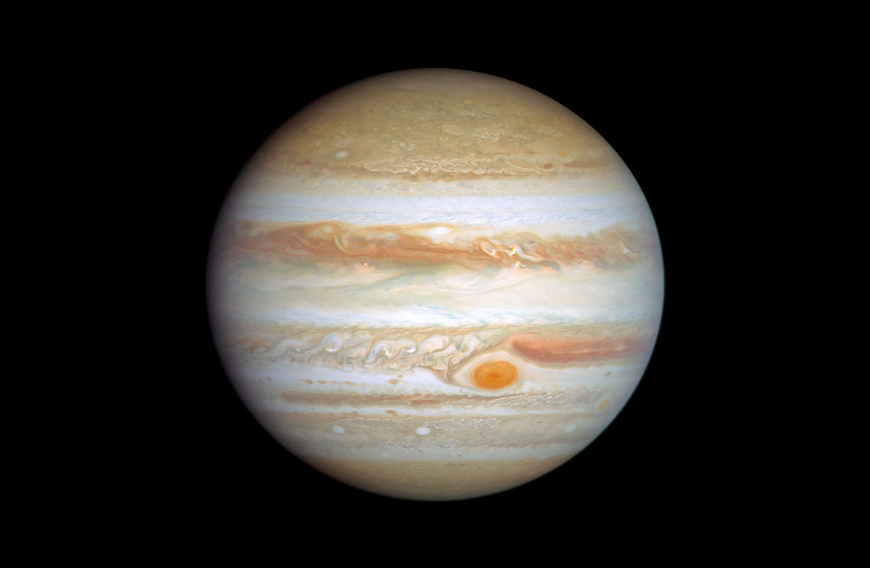
Humanity has long understood that Earth’s future is closely tied to the evolution of the Sun, which will eventually become too bright and hot for our planet to remain naturally habitable. While conventional thinking suggests that future civilizations may ultimately need to leave Earth, a new theoretical proposal explores an entirely different possibility: engineering the Solar System to keep Earth suitable for life for billions of additional years. The concept, published in the Journal of the British Interplanetary Society, was developed by independent researcher Gabriel Harry and describes a series of enormous engineering projects that could theoretically extend Earth’s habitability by as much as 9.1 billion years. Scientists expect the Sun to gradually increase in brightness over the next billion years, raising temperatures on Earth to levels that could eventually cause the oceans to evaporate and make the planet hostile to life. Much later, the Sun is expected to expand into a red giant, fundamentally transforming the inner Solar System and potentially engulfing the inner planets. Harry’s proposal attempts to address these challenges by changing Earth’s environment and orbital position rather than abandoning the planet. One of the first proposed solutions is an enormous artificial sunshade designed to reduce the amount of solar energy reaching Earth. The structure would reportedly stretch roughly 700,000 kilometers and could be positioned near the Sun-Earth L1 Lagrange point, where gravitational forces create a relatively stable location between the two bodies. The proposed shield would be extraordinarily larger than any structure humanity has ever built, although the concept suggests that it could be made from an extremely thin layer of aluminum. The material requirements would still be immense, potentially requiring aluminum equivalent to around 0.01 percent of the Moon’s total mass. The project would also require millions of kilometers of carbon cable, with a substantial portion of the necessary material potentially coming from the dwarf planet Ceres. However, blocking the Sun’s increasing radiation would create another problem because Earth would receive less natural light and heat. To address that challenge, Harry proposes constructing an artificial energy source capable of replacing some of the Sun’s functions. The concept involves placing fusion reactors deep inside Jupiter’s atmosphere, where hydrogen and helium could potentially serve as fuel for generating enormous amounts of energy. That energy could then be transmitted through a network of relay stations and directed toward Earth using powerful laser systems, effectively providing artificial illumination and heat. The proposal goes even further by considering how Earth’s orbit could eventually be changed as the Sun continues to evolve. As the habitable region around the Sun shifts outward, Earth would potentially need to move farther away to remain at a suitable temperature. Harry suggests that an extremely powerful particle beam could theoretically be used over long periods to gradually alter Earth’s orbit and move the planet into a safer region of the Solar System. Such an undertaking would require technological capabilities far beyond anything currently available. Controlling Earth’s orbit, constructing planetary-scale sunshades and generating energy from fusion systems inside Jupiter would present enormous engineering, material and safety challenges. The proposal is therefore not a practical near-term plan but rather a thought experiment about what an advanced civilization might eventually accomplish. Its importance lies in the scale of the question it raises: whether humanity’s long-term survival must depend on finding another planet or whether a sufficiently advanced civilization could transform its existing cosmic environment. The concept also illustrates how planetary engineering could eventually extend beyond climate management and become a tool for reshaping entire planetary systems. If humanity were ever capable of carrying out projects of this magnitude, Earth could potentially remain a home for life long after its natural environment would otherwise become unsuitable. For now, the proposal remains entirely theoretical, but it provides a striking perspective on the distant future of civilization and the possibility that Earth’s fate may not be determined solely by the natural evolution of the Sun.
Humanity has long understood that Earth’s future is closely tied to the evolution of the Sun, which will eventually become too bright and hot for our planet to remain naturally habitable. While conventional thinking suggests that future civilizations may ultimately need to leave Earth, a new theoretical proposal explores an entirely different possibility: engineering the Solar System to keep Earth suitable for life for billions of additional years. The concept, published in the Journal of the British Interplanetary Society, was developed by independent researcher Gabriel Harry and describes a series of enormous engineering projects that could theoretically extend Earth’s habitability by as much as 9.1 billion years. Scientists expect the Sun to gradually increase in brightness over the next billion years, raising temperatures on Earth to levels that could eventually cause the oceans to evaporate and make the planet hostile to life. Much later, the Sun is expected to expand into a red giant, fundamentally transforming the inner Solar System and potentially engulfing the inner planets. Harry’s proposal attempts to address these challenges by changing Earth’s environment and orbital position rather than abandoning the planet. One of the first proposed solutions is an enormous artificial sunshade designed to reduce the amount of solar energy reaching Earth. The structure would reportedly stretch roughly 700,000 kilometers and could be positioned near the Sun-Earth L1 Lagrange point, where gravitational forces create a relatively stable location between the two bodies. The proposed shield would be extraordinarily larger than any structure humanity has ever built, although the concept suggests that it could be made from an extremely thin layer of aluminum. The material requirements would still be immense, potentially requiring aluminum equivalent to around 0.01 percent of the Moon’s total mass. The project would also require millions of kilometers of carbon cable, with a substantial portion of the necessary material potentially coming from the dwarf planet Ceres. However, blocking the Sun’s increasing radiation would create another problem because Earth would receive less natural light and heat. To address that challenge, Harry proposes constructing an artificial energy source capable of replacing some of the Sun’s functions. The concept involves placing fusion reactors deep inside Jupiter’s atmosphere, where hydrogen and helium could potentially serve as fuel for generating enormous amounts of energy. That energy could then be transmitted through a network of relay stations and directed toward Earth using powerful laser systems, effectively providing artificial illumination and heat. The proposal goes even further by considering how Earth’s orbit could eventually be changed as the Sun continues to evolve. As the habitable region around the Sun shifts outward, Earth would potentially need to move farther away to remain at a suitable temperature. Harry suggests that an extremely powerful particle beam could theoretically be used over long periods to gradually alter Earth’s orbit and move the planet into a safer region of the Solar System. Such an undertaking would require technological capabilities far beyond anything currently available. Controlling Earth’s orbit, constructing planetary-scale sunshades and generating energy from fusion systems inside Jupiter would present enormous engineering, material and safety challenges. The proposal is therefore not a practical near-term plan but rather a thought experiment about what an advanced civilization might eventually accomplish. Its importance lies in the scale of the question it raises: whether humanity’s long-term survival must depend on finding another planet or whether a sufficiently advanced civilization could transform its existing cosmic environment. The concept also illustrates how planetary engineering could eventually extend beyond climate management and become a tool for reshaping entire planetary systems. If humanity were ever capable of carrying out projects of this magnitude, Earth could potentially remain a home for life long after its natural environment would otherwise become unsuitable. For now, the proposal remains entirely theoretical, but it provides a striking perspective on the distant future of civilization and the possibility that Earth’s fate may not be determined solely by the natural evolution of the Sun.
Tags
news
Comments (0)
Login to post comments
No comments yet
Be the first to share your thoughts about this post.