News
General
16 views
‘Don’t fear failure. Go for it’: Jena Zangs on building responsible AI strategy in higher education
Jul 07, 2026
📍 Philadelphia, PA, USA
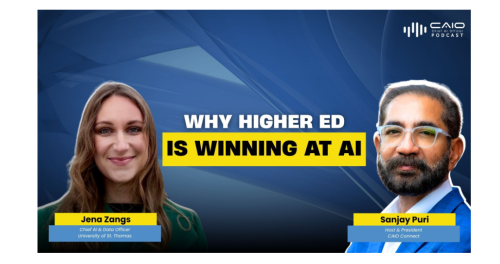
Artificial intelligence is reshaping higher education, but lasting success will depend on trust, governance, and purpose rather than technology alone, according to Jena Zangs, Chief Data and AI Officer at the University of St. Thomas, during a recent episode of the CAIO Connect podcast.
Speaking with host Sanjay Puri, Zangs reflected on her journey from organizing alumni events to leading enterprise AI strategy, demonstrating how curiosity and continuous learning can open unexpected career opportunities. She explained that learning programming and data science transformed her professional path and ultimately led her into AI leadership.
Zangs emphasized that universities must ensure every AI initiative directly supports student success. Rather than adopting artificial intelligence simply because it is available, institutions should measure its impact through improved learning outcomes, workforce readiness, research capabilities, and operational efficiency.
She also highlighted the importance of preparing students for an AI-driven future by integrating emerging technologies into academic programs, internships, and career development initiatives. According to Zangs, higher education must evolve alongside the rapidly changing technology landscape.
A major focus of the discussion was responsible AI implementation. Zangs said organizations need strong governance frameworks, reliable data infrastructure, and clear leadership collaboration before deploying advanced AI systems at scale. At the University of St. Thomas, close coordination between technology leadership and AI strategy helps balance innovation with security, privacy, and institutional stability.
The university has also developed internal AI tools, including chatbot technologies and early agentic AI applications designed to improve student services, alumni engagement, and administrative operations. By building many solutions internally, the institution has been able to maintain flexibility while controlling costs.
Looking ahead, Zangs believes artificial intelligence will transform jobs rather than replace them. She compared today's AI revolution to earlier technological shifts that changed how people work while creating entirely new opportunities for innovation and critical thinking.
She concluded that the organizations best positioned for the future will not necessarily be those adopting AI the fastest, but those building trusted, ethical, and human-centered AI ecosystems capable of delivering long-term value.
Speaking with host Sanjay Puri, Zangs reflected on her journey from organizing alumni events to leading enterprise AI strategy, demonstrating how curiosity and continuous learning can open unexpected career opportunities. She explained that learning programming and data science transformed her professional path and ultimately led her into AI leadership.
Zangs emphasized that universities must ensure every AI initiative directly supports student success. Rather than adopting artificial intelligence simply because it is available, institutions should measure its impact through improved learning outcomes, workforce readiness, research capabilities, and operational efficiency.
She also highlighted the importance of preparing students for an AI-driven future by integrating emerging technologies into academic programs, internships, and career development initiatives. According to Zangs, higher education must evolve alongside the rapidly changing technology landscape.
A major focus of the discussion was responsible AI implementation. Zangs said organizations need strong governance frameworks, reliable data infrastructure, and clear leadership collaboration before deploying advanced AI systems at scale. At the University of St. Thomas, close coordination between technology leadership and AI strategy helps balance innovation with security, privacy, and institutional stability.
The university has also developed internal AI tools, including chatbot technologies and early agentic AI applications designed to improve student services, alumni engagement, and administrative operations. By building many solutions internally, the institution has been able to maintain flexibility while controlling costs.
Looking ahead, Zangs believes artificial intelligence will transform jobs rather than replace them. She compared today's AI revolution to earlier technological shifts that changed how people work while creating entirely new opportunities for innovation and critical thinking.
She concluded that the organizations best positioned for the future will not necessarily be those adopting AI the fastest, but those building trusted, ethical, and human-centered AI ecosystems capable of delivering long-term value.
Tags
news
Comments (0)
Login to post comments
No comments yet
Be the first to share your thoughts about this post.